

Looking for the best free dropshipping websites without adding another monthly tool to your budget?
The options below can help with supplier research, store building, product research, marketing, analytics, and ecommerce learning without requiring a monthly subscription for the basic access covered here.
But keep in mind: Free does not mean running a dropshipping business costs nothing.
Some options below have free plans, while others give you a free tool or no monthly platform fee.
Best Free Dropshipping Websites Shortlist
Here's our shortlist of the top free dropshipping website tools in 2026:
- Best for Broad Supplier Marketplace: AliExpress - Covers almost every niche through a huge marketplace with free access, making it easy to compare sellers and products before ordering.
- Best for Sourcing and Fulfillment: CJdropshipping - Combines sourcing requests, fulfillment, and ecommerce integrations in a $0 basic account, with local warehouses that can shorten delivery when stock is available near the customer.
- Best for Free Supplier App: Modalyst - Connects online stores to a dropshipping supplier catalog through a free Hobby plan capped at 25 products.
- Best for Sourcing Support: Sup Dropshipping - Helps locate supplier alternatives through a free Basic plan with up to five product sourcing requests per day, while product and fulfillment costs remain separate.
- Best for Sourcing-Agent Workflow: HyperSKU - Adds sourcing-agent support without a subscription fee, accepting product or AliExpress links for sourcing while product, shipping, and fulfillment costs remain separate.
- Best for Print on Demand: Printful - Enables custom-product selling through a $0 plan with store connections, product creation, and automatic fulfillment, while product and shipping costs apply per order.
- Best for Self-Hosted Store Building: WooCommerce - Gives WordPress stores a free open-source ecommerce foundation with extensive setup control, while hosting and optional themes or extensions can still add costs.
- Best for Simple Hosted Storefront: Square Online - Runs as a simple hosted storefront on a $0 monthly plan, while payment processing still applies and connecting a custom domain requires a paid plan.
- Best for US-Only Free Storefront: Shift4Shop - Bundles hosting and its full feature set into a $0 End-to-End Ecommerce plan for eligible US merchants who use Shift4 Payments.
- Best for Very Small Catalogs: Mozello - Fits tiny-catalog testing with free hosting for up to five products, 0.5 GB of storage, and a Mozello subdomain.
You do not need all of them, so pick the resource that solves the next problem you actually have, then check its free-plan limits before building your workflow around it.
How we picked these
We compared 30 free dropshipping websites and asked one simple question: Would free access actually help you complete a real dropshipping task before you pay for an upgrade?
To answer that, we checked:
- What the free access actually lets you do
- The main usage, product, or account limits
- Its role in a dropshipping workflow
- Compatibility with common store setups
- Ease of getting started
- Current availability and practical usefulness
The 24 websites below made the list because each has a clear free use. We left options out when the free access was too limited, had disappeared, or another resource covered the same job better.

Start your store on Shopify
Free 3-day trial + $1/month for 3 months
- Grows with you from first test product to full brand
- Thousands of apps and hundreds of themes to customize your store
- Beginner-friendly editor with pro features when you're ready
No card to start. Cancel anytime.
The best free dropshipping sites: overview
Here is the full list of 24 sites; you can compare what each one does, what you can use for free, and the main limit to check before relying on it:
| Website | Best for | Free access | Main limit or cost |
| AliExpress | Broad supplier marketplace | Free marketplace access | Quality, shipping, and returns vary by seller |
| CJdropshipping | Sourcing and fulfillment | $0 basic account | You pay product, shipping, and fulfillment costs |
| Modalyst | Supplier app | $0 Hobby plan | 25-product cap on the free plan |
| Sup Dropshipping | Sourcing support | Free Basic plan | Five sourcing requests per day on the free tier |
| HyperSKU | Sourcing-agent workflow | No required subscription fee | You pay for products, shipping, and fulfillment services |
| Printful | Print on demand | $0/month plan | You pay product and shipping costs when orders are placed |
| WooCommerce | Self-hosted store building | Free open-source plugin | Hosting and optional extensions can still cost money |
| Square Online | Simple hosted storefront | $0/month Free plan | Payment processing applies and a custom domain needs a paid plan |
| Shift4Shop | Hosted store for eligible US merchants | $0/month End-to-End plan | US-only free plan tied to Shift4 Payments |
| Mozello | Very small catalogs | Free hosted plan | Five products, 0.5 GB storage, and a Mozello subdomain |
| Koala Inspector | Shopify competitor research | Free plan | 15 monthly tokens for deeper reports |
| My Ad Finder | Facebook ad research | Free Chrome extension | Research is based on ads shown in your Facebook feed |
| AliExpress Dropshipping Center | AliExpress product research | Free access | Focused on AliExpress data and listings |
| Niche Scraper | Exploring a product research platform | Limited free access | Full tools and higher usage require a paid plan |
| Shopify Tools | Store setup utilities | Free generators and templates | Useful for individual tasks, not a full store platform |
| Organic discovery | Free business account | Traffic takes ongoing content work and is not guaranteed | |
| Google Trends | Search-interest checks | Free | Shows relative search interest, not sales or profit |
| Contentsquare | Behavior analytics | Free plan | Current free plan captures up to 200,000 sessions per month |
| Thieve.co | Small sourcing and content tasks | Several free tools | The main product research platform is paid |
| Do Dropshipping | Dropshipping education | Free guides and tools | Editorial resource, not a supplier or store platform |
| Shopify Blog and guides | Ecommerce learning | Free to read | Shopify-specific content naturally reflects Shopify's platform |
| Canva Design School | Design skills | Many free courses and lessons | Some courses and Canva features are Pro-only |
| Meta Blueprint | Meta advertising education | Free online learning | Focused on Meta's own platforms |
| HubSpot Academy | Marketing and SEO education | Free training library | General marketing resource rather than dropshipping-specific training |
These 24 free dropshipping websites cover suppliers and fulfillment, store building, product research, marketing and analytics, plus ecommerce learning.
Before you choose one, check what becomes paid once you move beyond the free access shown above.
Tip: Looking for one specific job? Use 'Post Contents' at the top of the article to jump straight to the relevant section.
Free dropshipping sites for finding suppliers
If you decide to test dropshipping, your supplier affects far more than the product price because shipping, stock, returns, and problem orders all depend on that choice.
The platforms below don't charge a normal monthly membership fee for basic supplier access, but that doesn't make fulfillment free.
You still pay for products, shipping, and any optional services you use.
For more options, see our full guide to free dropshipping suppliers.
1. AliExpress

AliExpress lets you browse a huge product catalog without paying for a supplier membership, with products across almost every niche and sellers you can compare before ordering.
The trade-off is that AliExpress is a marketplace, not one supplier, so shipping and product quality can vary by seller, as can stock and return handling.
If AliExpress fits your sourcing model, tools in our AliExpress dropshipping app guide can help you import products and sync orders.
You can also compare it with the other options in our dropshipping supplier guide.
2. CJdropshipping

CJdropshipping is useful if you want sourcing, fulfillment, and store integration in one supplier platform without a required monthly fee for the basic account.
The basic account includes product sourcing requests and ecommerce platform connections without a monthly fee, while you pay for products, shipping, and other fulfillment services.
CJdropshipping also operates local warehouses in several markets, which can shorten delivery for products stocked near your customer.
Warehouse availability still depends on the item and destination.
For Shopify, CJdropshipping offers an app to connect your store and manage products and orders. You can see our CJdropshipping Shopify guide for the setup.
For a closer look at this supplier, read our CJdropshipping review.
3. Modalyst

Modalyst connects online stores with a catalog of dropshipping suppliers and offers a free Hobby plan.
The free plan lets you add up to 25 products.
Modalyst is worth comparing if you want a supplier app instead of ordering manually from a marketplace.
Supplier location and shipping still vary inside the platform, so check the individual supplier's product terms before listing an item.
See our Modalyst review for an in-depth look at its pros, cons, and paid plans.
4. Sup Dropshipping

Sup Dropshipping is a sourcing and fulfillment platform that can help you find alternatives to products you spot on marketplaces such as AliExpress.
Its Basic plan is free and currently includes up to five product sourcing requests per day, while image search and product-import limits are separate.

That makes it useful when you already have a product idea and want help locating a supplier rather than browsing a catalog from scratch.
The free tier still has usage limits, and you pay for the products and fulfillment you order. Check those costs before comparing them with a marketplace supplier.
5. HyperSKU
HyperSKU takes a similar sourcing-agent approach.
There is no subscription fee to create an account and use its sourcing workflow, where you can submit a product or AliExpress link and ask HyperSKU to source it.
You pay for the product and shipping, while fulfillment services tied to your orders can add more costs.

This setup can make more sense once you want a sourcing team involved.
Before moving orders, compare the quote and shipping route, then check branding and return handling.
For more detail, see our HyperSKU review.
6. Printful

If you want to sell custom products instead of sourcing ready-made items, Printful has a free plan.
You can connect a store, create products, and use automatic fulfillment without a monthly subscription.
Printful says most orders are fulfilled within two to five business days. Delivery time comes after that and depends on the shipping method and destination.
The paid Growth plan adds product discounts and other benefits, but you don't need to pay to explore the catalog.
Free websites for building a dropshipping store
If you decide to build a storefront, 'free' can mean two different things: free software that you host yourself, or a hosted platform with a restricted $0 plan.
Neither route removes every cost: self-hosted software still needs hosting, while hosted free plans can limit your domain, catalog size, payment options, or eligibility.
For a more in-depth comparison, see our guide to the best ecommerce platforms for dropshipping.
1. WooCommerce
WooCommerce is the open-source ecommerce plugin for WordPress.
The core software is free, giving you a lot of control over how you build the store.
The catch is that the store itself isn't free to run, because you still need WordPress hosting and may also pay for themes or extensions, depending on the setup.
Security tools and developer help can add to the cost too.
WooCommerce is a stronger fit if you want control and are comfortable managing more of the technical side yourself.
A hosted platform can be simpler if you would rather have hosting and store infrastructure handled for you.
Our WooCommerce dropshipping guide walks through the setup and costs in more detail.
Useful links:
2. Square Online

Square Online has a free plan with hosting included, although payment-processing fees still apply when a customer pays online.
On Square's current US pricing page, the Free plan lists online payments at 3.3% + 30¢ per transaction.
The free plan works for a simple storefront, but it doesn't include every branding and domain feature. In particular, connecting a custom domain requires a paid plan.
That makes Square worth considering for a low-cost test if its payment setup and store features fit you, but compare the transaction costs and app integrations before treating it as a long-term dropshipping platform.
You can check the current Square Online pricing and plan limits.
3. Shift4Shop
Shift4Shop currently offers a free End-to-End Ecommerce plan with hosting and its full feature set.
However, it has a major eligibility limit: the free plan is only available to US merchants and requires Shift4 Payments.
If you are outside the US, Shift4Shop's store plans are paid.
If you are in the US, compare its payment setup and supplier integrations with the other platforms before choosing it simply because the monthly platform fee is $0.
4. Mozello

Mozello is a small website builder with a free plan and hosting included.
Its free ecommerce limits are strict: the store can contain up to five products, storage is capped at 0.5 GB, and you use a Mozello subdomain instead of your own domain.
Mozello does not add its own sales commission on the free plan, although your payment provider can still charge processing fees.
The five-product cap makes this better for a tiny catalog or early test than for a store that needs room to expand.
One useful feature is multilingual site support, which the platform includes.
See the current Mozello plans and features before building around the free tier.
Free dropshipping product research sites
Product research tools can help you find ideas and compare signals, but none can tell you a product will be profitable before you sell it.
Use these tools to narrow the search, then check the supplier and real product cost before looking at competition, your creative angle, and real customer response.
Our product research tools guide covers more paid and free options.
1. Koala Inspector
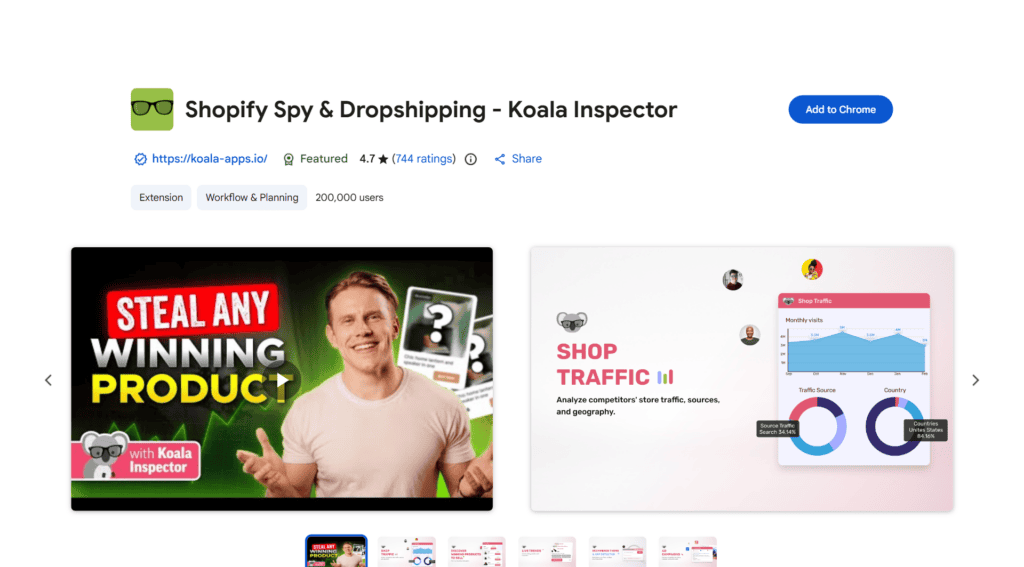
The free Koala Inspector Chrome extension is useful when you want to inspect how a Shopify store is set up.
On the free tier, you can inspect the store's theme and apps as well as its products, newest items, and best sellers.
The account also includes 15 monthly tokens for deeper reports.
2. My Ad Finder

If you want to save ad examples while browsing Facebook, the My Ad Finder Chrome extension collects ads from your feed so you can review them later.
That can be useful for studying hooks and formats, then comparing offers and product angles. You can also compare the examples with our Facebook Ad examples.
3. AliExpress Dropshipping Center

AliExpress Dropshipping Center adds research tools on top of the normal AliExpress catalog.
Its product search lets you filter by category and price, then narrow results by shipping location and delivery-related options.

You may also see interface labels such as 'Winning products' inside the tool.
For the full workflow, see our AliExpress Dropshipping Center guide.
4. Niche Scraper

Niche Scraper is primarily a paid product research platform, but it offers limited free access.
The free access gives you limited searches and a smaller part of the research workflow. It is enough to explore the interface, but the paid plan is required for the full toolset and higher usage.
Our Niche Scraper review goes through the features and limitations in more detail.
Free marketing and analytics sites for dropshipping
A supplier and storefront are only part of the job, so you may also need help naming a business, checking search interest, finding organic traffic, or seeing where visitors struggle on your site.
The tools below cover those jobs, and for a bigger directory, browse our dropshipping tools page.
1. Shopify Tools
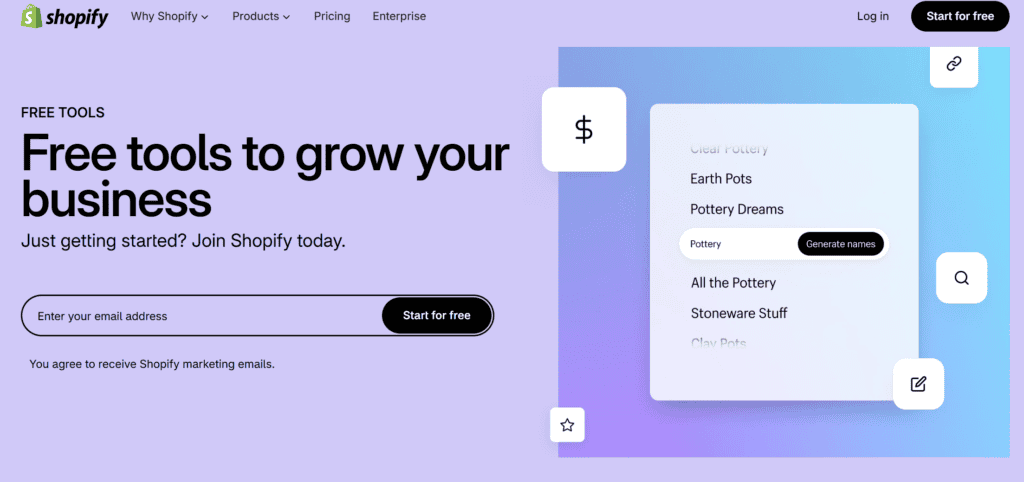
Shopify Tools is a collection of free utilities from Shopify.
You do not need to use every tool or even choose Shopify as your store platform to get value from the basic generators.
Current examples include a logo maker, business name generator, domain and QR code tools, plus policy templates.
- Logo Maker
- Business name generator
- Domain and QR code generators
- Policy template generators
Use the policy generators as templates, not legal advice, because your store's actual policies still need to match what you sell, where you sell, and how your supplier handles fulfillment and returns.
2. Pinterest

Pinterest can be a free traffic channel if your products fit a visual, search-led audience and you are willing to publish Pins consistently.
A Pinterest business account is free and includes analytics, while paid ads are optional, so you can test organic content before deciding whether the channel deserves ad spend.
We have seen that organic reach work firsthand: One store account generated more than two million Pin impressions over two months:

If you want the process we used, read our guide to getting free traffic from Pinterest.
3. Google Trends
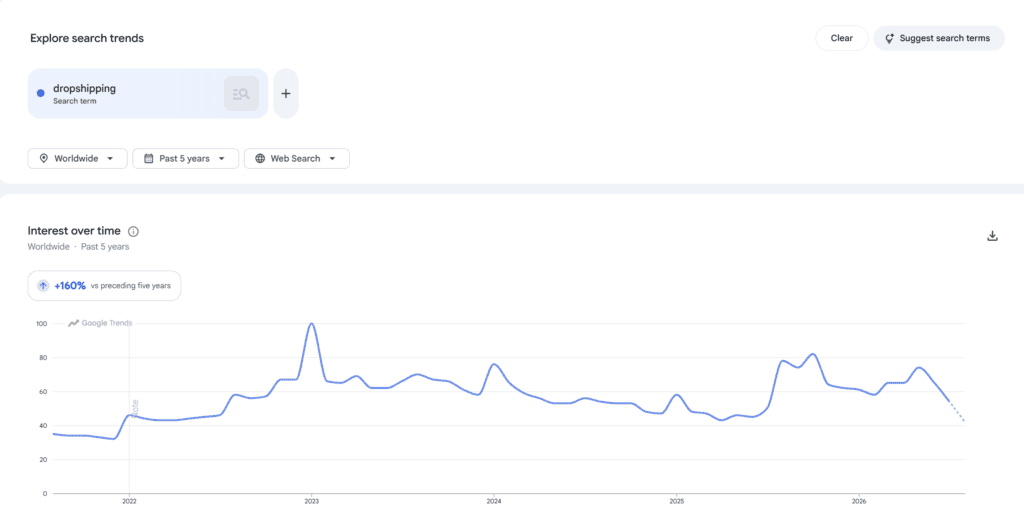
Google Trends is one of the simplest free ways to compare how search interest changes over time and between regions.
You can compare product names and niches before spending money on a research tool. Seasonal terms and related searches can add more context.
The important limitation is that Google Trends shows relative search interest. It does not tell you exact sales demand, profit potential, or how much competition you will face.
Our Google Trends for dropshipping guide shows how to use those signals without treating the chart as sales data.
4. Contentsquare (formerly Hotjar)
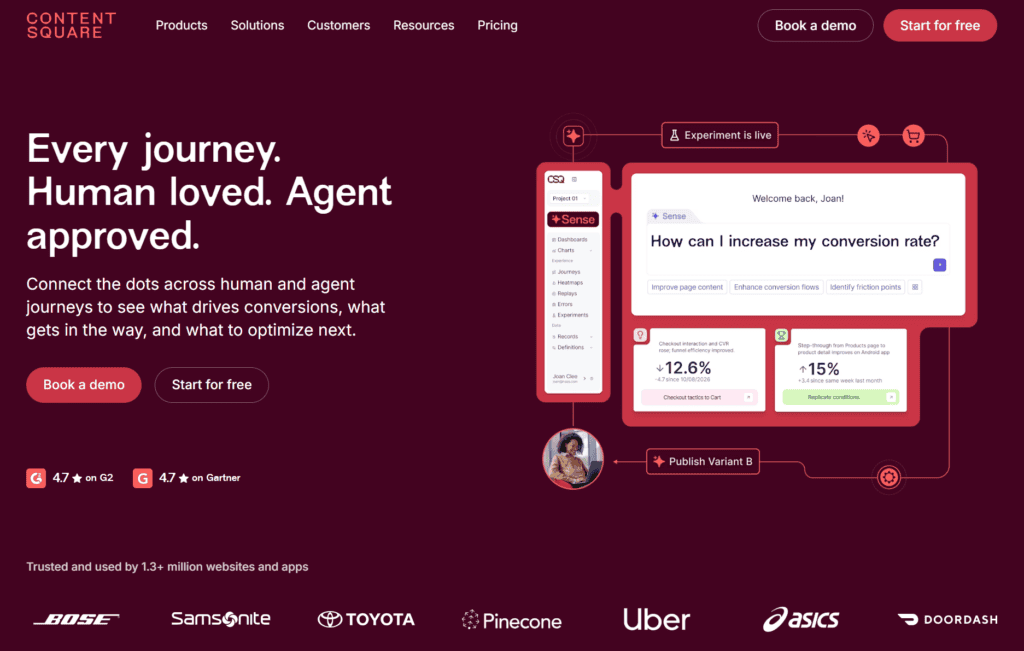
Hotjar has moved into Contentsquare, so new users can no longer sign up for the old standalone Hotjar product.
Contentsquare still offers a free plan with the tools most readers used in Hotjar, including heatmaps, session replay, surveys, and funnels.
The current free plan allows up to 200,000 captured sessions per month. That is plenty for testing behavior analytics on a small store, but you should still check the latest plan limits before relying on a specific feature.
Use recordings and heatmaps to find friction, then look for repeated patterns such as dead clicks and ignored buttons rather than guessing what a visitor was thinking.
If you spot a drop-off point, test the page change rather than assuming the cause.
5. Thieve.co

Thieve.co has a paid product research product, but its site also includes several free tools you can use separately.
The current free-tool area includes supplier finding, reverse image search, product-content tools, and a niche research tool.
That makes Thieve useful when you need one small research or content task without paying for the full product research platform.
If you are considering the paid side as well, our Thieve.co review covers the wider feature set.
Free dropshipping and ecommerce learning websites
You can learn a lot before paying for a course, especially while you are still deciding which business model, platform, or marketing channel actually fits you.
The resources below cover dropshipping and ecommerce, plus design, ads, SEO, and marketing.
You can find more options in our guides to dropshipping resources and dropshipping blogs.
1. Do Dropshipping
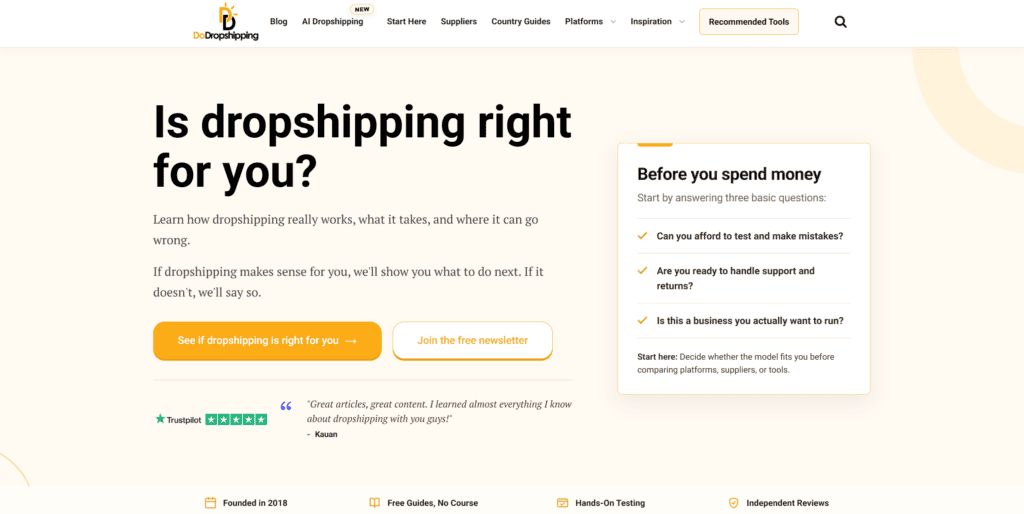
Yes, we are including Do Dropshipping here.
Every guide on the site is free to read, and our goal is to help you understand how dropshipping works before you spend money.
If you choose to continue, we can then help with supplier, platform, research, marketing, and store decisions.
You will also find free checklists and comparisons, plus prompts and interactive tools around the site. Start with the topic you are trying to solve rather than reading everything in order.
2. Shopify Blog and guides
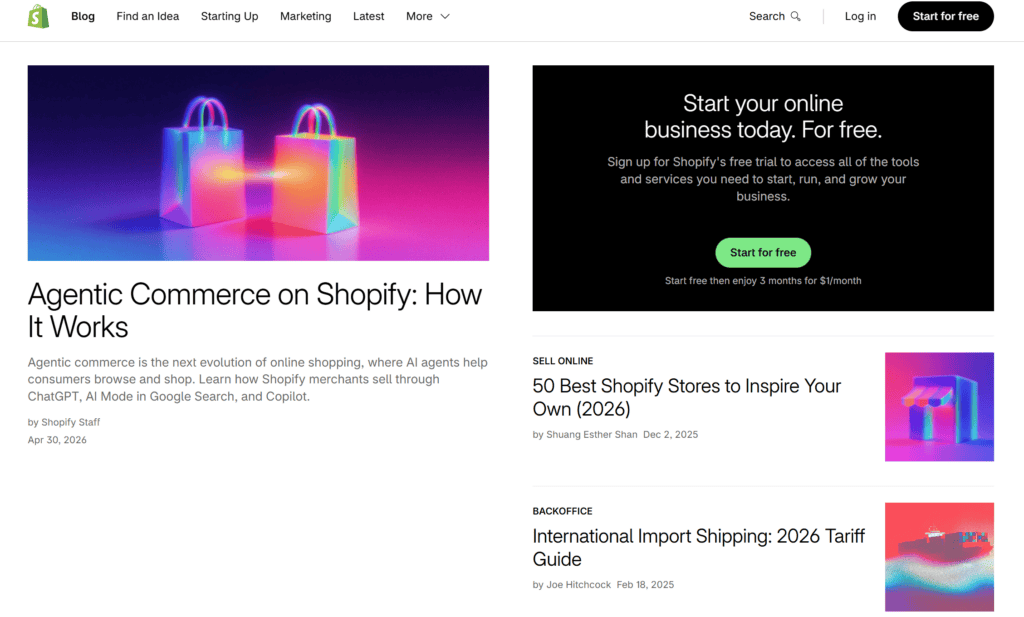
Shopify's blog and guide library is free to read and covers a wide range of ecommerce topics.
The library covers ecommerce basics, marketing, and product ideas. You will also find store-design, logistics, and Shopify-specific guides.
Keep the source in mind: Shopify publishes these guides, so platform-specific articles naturally explain the problem from a Shopify perspective.
For general ecommerce decisions, compare that advice with independent sources too.
3. Canva Design School

Canva Design School is useful when the part you need to improve is visual rather than dropshipping-specific.
It includes courses and lessons on Canva, design, branding, presentations, and content creation.
Many learning resources are free, although some Canva features and courses can require Pro access.
If you have never used the design tool itself, Canva also has a free plan that is enough for many basic store graphics and social posts.
4. Meta Blueprint

If Meta ads are one of the channels you are considering, Meta Blueprint gives you free training from Meta itself.
The catalog covers Facebook and Instagram advertising, plus campaign setup and measurement. It also includes creative training and other Meta products.
It is useful for learning how Meta's own ad system works.
For strategy questions such as whether paid social is the right channel for your margins and product, you still need to make that decision outside the course.
5. HubSpot Academy

You do not need to use HubSpot software to learn from HubSpot Academy.
The training library is free and covers SEO, social media, and inbound marketing. You can also find courses on email, sales, and content marketing.
This is a good resource when your problem is a marketing skill rather than a dropshipping-specific setup question.
Pick the course that matches the channel you are working on instead of collecting certificates you will not use.
How to choose the best free dropshipping sites for your needs
You do not need a 24-tool stack, so start with the job in front of you:
- Need a supplier? Start by matching the supplier to the product and fulfillment model. AliExpress, CJdropshipping, and Modalyst cover different supplier setups. Sup Dropshipping and HyperSKU focus more on sourcing support, while Printful is for print on demand.
- Need a storefront? WooCommerce gives you more control, while Square Online offers a simple, free hosted tier. Shift4Shop's free plan is US-only, and Mozello fits very small catalogs.
- Need product ideas? Koala Inspector and My Ad Finder can give you research signals. AliExpress Dropshipping Center and Niche Scraper add different discovery tools. None can guarantee a profitable product.
- Need traffic or analytics? Pinterest, Google Trends, and Contentsquare solve very different jobs. Choose the one that matches the question you are trying to answer.
- Need to learn? Do Dropshipping and Shopify's blog cover ecommerce topics. Canva Design School, Meta Blueprint, and HubSpot Academy are useful when you need a specific skill.
Before you commit, check the exact free-plan limit again because product caps, transaction fees, feature access, and free tiers can change.
Conclusion
The best free dropshipping sites solve a real problem before you need to pay for a bigger tool or platform, whether that means removing an early cost or helping you make a decision before you spend money.
The mistake is building your whole setup around the word 'free' without checking what happens next.
A supplier can have no monthly fee and still be expensive after product and shipping costs, while a free store builder can cap products or domains.
A research tool can also show useful signals without proving demand.
If you decide to test dropshipping, start with the smallest set of tools that covers your next step. Add a paid tool only when its extra features solve a problem you actually have.
For a wider directory, see our guide to dropshipping websites and companies.
Want to learn more about dropshipping?
Here's what we'd read next:
New to the business model?
Our guide to starting dropshipping covers what it takes before you decide whether to continue.







2 Comments
Hi!
I love your articles! Thank you for writing them. I want to know how I bring traffic to my shopify store (it’s still in building it process) I don’t go on social media much so I don’t have any followers or of that type stuff. How do I generate traffic?
Hi Netty,
Amazing to hear that you love the articles! In terms of getting traffic to your Shopify store, I think this article will give you a great overview of all your options:
Marketing for Dropshipping: 8 Strategies and How to Choose
Have a great rest of your day!
– Patryk