Dropshipping has some real advantages, but it also comes with tradeoffs that are easy to underestimate when you're just getting started.
The biggest disadvantages usually come from relying on a supplier for inventory and fulfillment. That dependence can affect shipping and product quality, while stock issues or returns can also shape the customer experience.
The good news is that many of these problems can be reduced with a better setup. Some, however, are simply part of the model and need to be weighed against the benefits.
Let's go through eight of the biggest disadvantages and what you can do about them.
Key takeaways
- Verdict: Dropshipping has real downsides. Many can be reduced with good suppliers and better planning, but some are inherent to outsourcing fulfillment.
- Biggest tradeoffs: You have less control over fulfillment, while stock and product quality depend partly on your supplier. Margins can also be thinner than buying in bulk.
- What helps: Order samples, communicate with suppliers, and keep backup options ready before you need them. Clear shipping and return policies also prevent avoidable surprises.
- What doesn't disappear: Your supplier still controls important parts of fulfillment, so some delays or mistakes will be outside your direct control.
- Next step: Compare these downsides with the advantages of dropshipping, then decide whether the tradeoffs fit what you want to build.

1. Less control over fulfillment
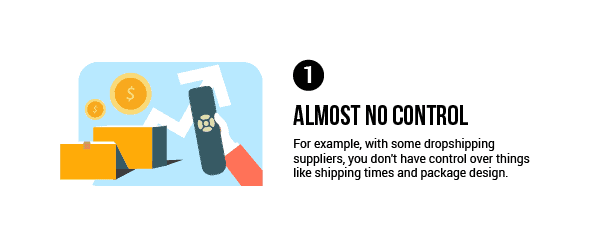
This is probably the biggest disadvantage of dropshipping.
Your supplier stores the products and handles fulfillment, so you don't control every step after a customer places an order.
Depending on the supplier, this can include shipping speed and packaging, as well as stock availability and order-processing time.
You still control important parts of the business, including which suppliers you work with and what you promise customers.
But when something goes wrong in fulfillment, you're often relying on somebody else to help fix it.
How can you manage this disadvantage?
The best time to reduce fulfillment problems is before you start sending orders.
Ask potential suppliers how quickly they process orders and where they ship from, then check what packaging they use and how they handle damaged or missing shipments.
I'd also place a test order so you can see the process from the customer's side.
If one supplier can't meet the experience you want to offer, compare other suppliers or look for ways to get faster dropshipping delivery.
And if a product eventually proves itself, you can compare dropshipping with buying inventory in bulk or using a fulfillment service.
That can give you more control, but it also introduces new costs and inventory risk, so I wouldn't treat it as an automatic upgrade.
Here's a useful video if you want to understand what moving toward bulk inventory can involve:

2. Orders can arrive in multiple packages

This can happen when different products are fulfilled by different suppliers or warehouses.
If a customer buys two products from your store, one item may arrive several days before the other. You may also pay separate shipping costs for each package.

Without clear communication, the customer may think part of the order is missing when the first package arrives.

How can you manage this disadvantage?
Where possible, try to source related products from the same supplier or fulfillment location.
If split shipments are unavoidable, account for the additional shipping cost before pricing the order.
It also helps to inform customers that an order may arrive in multiple packages and to send tracking information for each shipment.
You can explain this on your FAQ or shipping policy page so the customer knows what to expect before ordering.
If you use several suppliers, our guide on dropshipping with multiple suppliers goes into more detail.
3. Quality control is harder

When a supplier ships directly to the customer, you don't inspect every product before it leaves the warehouse.
That makes quality control harder than it would be if you stocked and checked the products yourself.
A product could arrive damaged or look different from the listing, and you may not know there's a recurring issue until customers start reporting it.
How can you manage this disadvantage?
Start by ordering a product sample to your own address.
That lets you check the product and packaging yourself and see how long the delivery takes.

You can even use the sample to create your own product photos or videos.
Just remember that one good sample doesn't guarantee every future unit will be identical.
Keep an eye on customer complaints and return reasons after launch. If the same quality issue keeps appearing, raise it with the supplier and be prepared to pause the product if necessary.
4. Supplier stock can change unexpectedly

You don't own the supplier's inventory, so stock can change without being fully under your control.
A product may start selling well just as your supplier runs low, or an item may become unavailable while you're still advertising it.
That's especially frustrating when customers have already placed orders.
How can you manage this disadvantage?
Stay in regular contact with your supplier and ask how much stock they normally hold, especially before increasing your marketing spend.
If your supplier offers inventory syncing, use it, but don't assume every stock feed is perfectly up to date.
It also helps to identify backup suppliers before you need them, but don't switch blindly just because another supplier lists the same product.
Check their product quality and shipping first, because the price or packaging may differ as well.
If a product goes out of stock and you're not confident in the alternative, pausing the product may be better than taking orders you may struggle to fulfill.
5. Profit margins can be thinner

One tradeoff for avoiding bulk inventory is that you may pay more per unit.
A supplier that stores and fulfills individual orders has costs of its own, and those costs are reflected in the price you pay.
That can leave you with less room between your selling price and your product cost than if you bought a large quantity at wholesale pricing.
Your real margin depends on more than product cost, because shipping and payment fees can take a cut alongside refunds and marketing costs.
How can you manage this disadvantage?
Instead of trying to solve a thin margin by simply selling more units, work backward from the economics of each sale.
Estimate the product's cost to you after shipping, then include payment fees and an allowance for refunds. If you use paid ads, include your expected customer acquisition cost as well.
Our guide to dropshipping profit margins can help you understand the numbers, while our pricing strategy guide covers how to turn those costs into a workable price.
If the numbers don't leave enough room, that product may simply not be a good fit for your store.
And if a product eventually sells consistently, you can compare the economics of dropshipping with buying in bulk or using a fulfillment partner.
That may improve the unit cost, but it also brings inventory and fulfillment expenses back into the picture.
6. Returns and refunds can get complicated

Returns are trickier when the product never passed through your hands in the first place.
Your customer deals with your store, but the product may need to go back to a supplier in another city or country.
That can make return shipping expensive or create confusion about who is responsible when an item arrives damaged or incorrect.
How can you manage this disadvantage?
Agree on the return process with your supplier before you start selling the product.
Find out where returns should go and what evidence the supplier needs for damaged or incorrect items. You should also know which situations they will refund or replace.
For a low-value item, it may sometimes cost less to refund or replace the product without asking the customer to ship it back. In other cases, returning it may make more sense.
There isn't a single workflow that fits every product or supplier, so your customer-facing return policy should align with what you can realistically support and with any consumer rules that apply where you sell.
Our guide to dropshipping returns and refunds goes through the process in more detail.
You can also use our return policy guide and template as a starting point.
7. Customer service depends partly on your supplier

You are the person your customer contacts, even when the answer depends on your supplier.
If a package is delayed or a product arrives damaged, you may need information from the supplier before you can give the customer a complete answer.
If the supplier is slow to respond, your own response time can suffer too.
How can you manage this disadvantage?
Work with suppliers that communicate clearly and provide a reliable way to escalate order issues.
It also helps to know the usual fulfillment and delivery timelines before customers ask about them.
Keep your own records of common issues and how the supplier handles them, and use that information to improve your FAQs and customer service replies.
A good FAQ page can answer common questions before they become support tickets.
And if you want a fuller setup, read our customer service guide for dropshipping stores.
8. Competition can be intense

Another downside is that other sellers may have access to the same products and suppliers that you do.
That makes it easy for several stores to end up selling similar products with the same supplier images and descriptions.
If your store looks interchangeable with everyone else's, customers have fewer reasons to choose you.
How can you manage this disadvantage?
You don't need to invent a product nobody has ever seen before.
Instead, give customers a clear reason to buy from your store.
That could mean better product information and stronger branding, or a more useful offer and clearer customer experience.
Use your own product descriptions where possible, and improve the supplier images if they don't align with your brand.
You can also build trust through better policies and customer service.
If you want more ideas, start with these guides:
- How to Create a Unique Dropshipping Store: 11 Practical Tips
- 7 Tips to Beat the Competition of Your Dropshipping Store!
Disadvantages of dropshipping: An overview
If that was a lot to take in, don't worry!
Here's the infographic version you can save for later:

What are the risks of dropshipping?
The disadvantages above are mainly about how the fulfillment model works.
There are also broader business risks to consider, from taxes and supplier scams to shipping costs and legal requirements that vary by where you operate.
Our guide to dropshipping risks to consider before starting covers those separately.
What are the advantages of dropshipping?
We've spent this article on the drawbacks, but dropshipping has advantages too.
The main benefits include:
- Testing products without buying in bulk
- Lower upfront inventory costs
- Not having to store, pack, or ship every order yourself
- Learning useful ecommerce skills
- A relatively quick technical setup
- More flexibility to expand your product range and test new markets
Our full guide to the advantages of dropshipping explains why each one can be useful and where the tradeoffs still apply.
Conclusion
So, there you have it!
Dropshipping gives you flexibility, but some of that flexibility comes from handing parts of fulfillment to somebody else.
That means supplier stock and fulfillment can affect your customers, while thinner margins or complicated returns can make the business harder to manage than it first appears.
The important question isn't whether every disadvantage can be fixed. It's whether the tradeoffs are acceptable for the kind of store you want to build.
If they are, good supplier relationships and clear customer expectations can make many of the problems easier to handle.
If one of these downsides feels like a dealbreaker, that's useful to know before you spend more time or money on the model.
You can compare the other side in our advantages of dropshipping guide or read our full pros and cons comparison.
Did I miss a disadvantage you've run into yourself? Let me know in the comments below!
Want to learn more about dropshipping?
Here are a few guides we'd read next:
- 6 Advantages of Dropshipping in 2026 and Tradeoffs to Know
- Pros and Cons of Dropshipping in 2026: What to Know
- 11 Dropshipping Risks to Consider Before Starting Your Store
New to dropshipping? Our beginner's guide explains how the model works and what to consider before you start.