If you sell to US customers, tariffs and the loss of de minimis have changed the math for dropshipping.
Most non-exempt goods of Chinese origin now face an additional 12.5% Section 301 tariff.
You also can't use the old $800 de minimis exemption for commercial low-value parcels.
In plain English: many products that used to be cheap and easy to ship are now more expensive and riskier to build a store around.
Quick Answer: How will tariffs affect dropshipping?If you rely on China-based suppliers shipping directly to US customers, your landed costs and customs workload are likely higher now.Most non-exempt Chinese-origin goods face a new 12.5% Section 301 tariff. Commercial low-value shipments can no longer rely on de minimis and need an appropriate customs entry.If your inventory is already in the US, or your product qualifies for an exemption, the impact may be smaller.Your real risk depends on the product's country of origin and tariff code. Existing duties and the customs setup matter too.
Use the Tariff Shock Risk Checker below to see how exposed your current setup is and what to focus on next:
Then keep reading for the full breakdown of what changed, why it matters, and what you can do to protect your margins and avoid expensive customs mistakes.

Disclaimer: We are not lawyers, and this post should not be considered legal advice. You should seek appropriate counsel for your own situation.
Start your store on Shopify
Free 3-day trial + $1/month for 3 months
- Grows with you from first test product to full brand
- Thousands of apps and hundreds of themes to customize your store
- Beginner-friendly editor with pro features when you're ready
No card to start. Cancel anytime.
A quick summary of what changed
Here's what you need to know before we continue.
In April 2025, US tariffs on many Chinese imports briefly peaked at 145%.
That headline rate didn't last. But for many products sourced from China, the replacement still adds a meaningful cost.
Effective July 24, 2026, the US Trade Representative imposed an additional 12.5% Section 301 tariff on most non-exempt goods of Chinese origin.
That doesn't mean your total rate is only 12.5%. Your product may also carry its normal tariff and other China trade remedies.
There are hundreds of product exemptions, so you can't calculate the real rate from the product category alone. You need the exact Harmonized Tariff Schedule of the United States (HTSUS) classification and country of origin.
If you're unsure, ask a licensed customs broker before you scale the product.
For example, if a non-exempt product has a customs value of $10, the new Section 301 duty is $1.25. Its total landed cost may be higher after normal duties and older China tariffs.
Shipping and entry-related fees can add more.
But tariffs are only half of the change.
For years, many eligible commercial shipments valued at $800 or less could enter the US under the Section 321 de minimis exemption without import duty.
That's one reason platforms like AliExpress, Temu, and Shein could send cheap parcels directly to US customers.
You can't use that route for commercial shipments anymore.
China and Hong Kong lost commercial de minimis treatment on May 2, 2025. The suspension expanded to shipments from all countries on August 29, 2025.
In June 2026, Customs and Border Protection made the suspension indefinite. The commercial-shipment exemption is also scheduled to disappear from the law on July 1, 2027.
So, how does a low-value parcel enter now?
- If it arrives through a commercial carrier such as FedEx or UPS, it needs an appropriate formal or informal customs entry. CBP says eligible shipments valued at $2,500 or less can generally use informal entry.
- If it arrives through the US Postal Service, eligible mail valued at $2,500 or less can use the new postal informal-entry process. During a delayed-compliance window through October 21, 2026, shipments subject to Chapter 99 duties can use that process too. Starting October 22, those shipments generally need formal entry unless the filer participates in CBP's voluntary Entry Type 13 test.
Your product may still qualify for an exception.
The July 2026 action exempts certain products, including some raw materials and goods already covered by separate trade measures. You need the tariff code for the exact product.
The bottom line is this:
- Most non-exempt Chinese-origin goods face a new 12.5% Section 301 tariff.
- That rate can stack with normal duties and other China trade remedies.
- The commercial $800 de minimis route is gone.
- Your exact cost depends on origin and classification. Exemptions and entry-related fees matter too.
This is a major wake-up call if you've been dropshipping from China.
You can't rely on the supplier price alone anymore. You need to recalculate every SKU using its full landed cost.
But you still have options.
Continue reading, and we'll show you what to check next.
Why is dropshipping so vulnerable to Trump's tariffs?
The tariff changes have exposed a major weakness in the dropshipping model.
At its core, dropshipping is built on one simple idea: buy a product for less and sell it for more. Your supplier handles the inventory and shipping.
For years, the common formula was:
- Source low-cost products from China.
- Ship them directly to customers in the US.
- Keep what remains after product costs, shipping, and advertising. Then subtract fees, refunds, and customer-service costs.
This worked especially well when eligible low-value parcels could use the $800 de minimis exemption.
Most dropshipping products, such as $15 kitchen gadgets or $20 beauty tools, sat comfortably under that limit.
Shipping was cheap, and customers rarely saw a separate customs step. The profit margins had more room too.
You no longer have that advantage.
Less room for margin
The loss of de minimis would already be difficult on its own. It now sits alongside an extra tariff layer on most non-exempt Chinese-origin goods.
For example, if your non-exempt product has a $10 customs value, the new Section 301 duty is $1.25. You may still owe normal duties and older China tariffs.
Carriers or customs brokers may also charge clearance, disbursement, or processing fees. Those fixed charges can hurt cheap products more than the tariff percentage itself.
You don't avoid customs entry by sending the product through the postal network.
So, a $5 bracelet or $15 kitchen tool has far less room for advertising costs and refunds.
You can raise the price, but higher prices can reduce conversion when the product is still positioned as a cheap impulse buy.
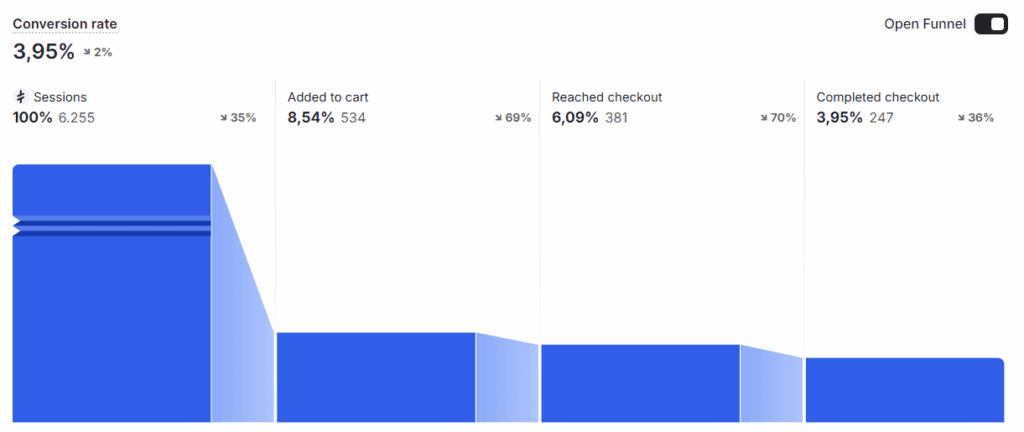
And the challenges go beyond the price.
Shipping delays
Customs entry adds another step. Delays are possible when the product data or classification is wrong, or when the duty payment fails.
A parcel may clear normally, be held for more information, or be returned if the shipment can't be entered correctly.
That can lead to customer complaints, refund requests, and chargebacks.
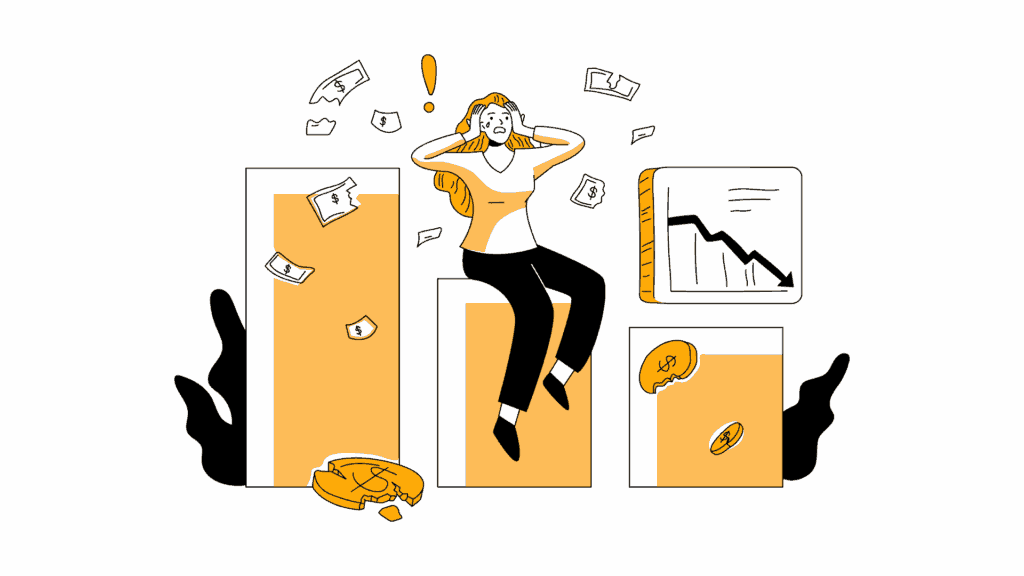
Customers may accept a longer delivery time when the price is low. But they are less likely to be patient when the same product costs more and arrives with an unexpected duty bill.
Before you advertise a product, ask your supplier who will be the importer of record. You should also confirm whether duties are prepaid and which customs documents the carrier needs.
Shock and frustration in the community
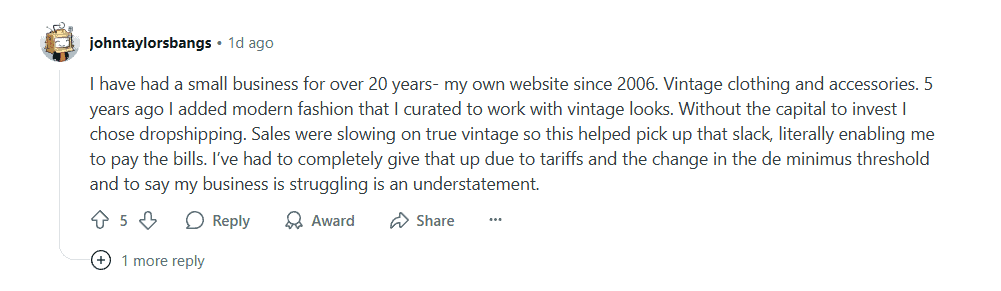
When the 145% headline rate landed in 2025, the reaction in the dropshipping community was intense.
Some sellers paused campaigns or stores while they worked out whether their products still made sense.
The screenshot below shows one Reddit seller's reaction from 2025:
You may be able to adapt faster if you already use US-based suppliers or hold inventory locally.
But stores built around cheap Chinese products sent one parcel at a time had to rethink their numbers quickly.
That doesn't mean dropshipping is dead.
It means you need to pay much closer attention to product economics and customs setup.
5 ways to adapt to the dropshipping tariffs
One thing is clear: you'll find the classic low-margin China-to-US model much harder to run.
If you want to keep selling, you need to rethink the product and supplier. Your fulfillment setup may need to change too.
Here are five practical options:
1. Reduce your dependence on Chinese suppliers
Moving your sourcing away from China doesn't make tariffs disappear. You may still face new duties because the July 2026 action covers dozens of other countries.
If the new product genuinely originates outside China, it can avoid some older China-specific duties. It also reduces your dependence on one sourcing country.
Important: 'Ships from' isn't the same as country of origin.
Sending a Chinese-made product through Vietnam, Indonesia, or Mexico doesn't automatically remove China duties.
The product must satisfy the applicable origin rules. Relabeling or rerouting it to hide its real origin can be treated as illegal transshipment or duty evasion.
With that warning in mind, here are some alternatives worth researching:
Vietnam, India, or Indonesia
These countries have been growing as manufacturing hubs for years, but moving production doesn't guarantee a lower US tariff.
Under the July 2026 action, Vietnam is in the same 12.5% band as China. India and Indonesia are at 10%, subject to product exemptions.
The tariff percentage is only one part of the decision. Compare minimum order quantities and quality control first.
Then check shipping routes and the full landed cost.
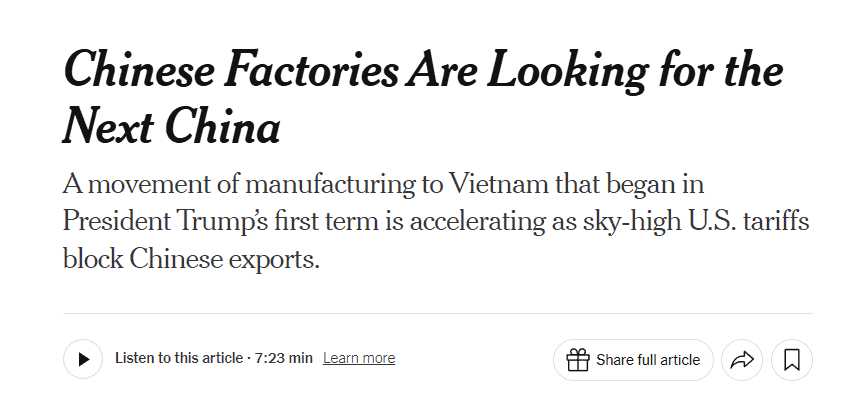
Some Chinese manufacturers were already shifting parts of their operations into Southeast Asia before the latest tariff change:
Platforms like Alibaba and IndiaMART can help you find manufacturers.
Some dropshipping agents also support fulfillment from Southeast Asia.
You can also check out our article on the best dropshipping suppliers in India here.
Mexico and Latin America
If you want to source closer to US customers, Mexico is worth researching.
Mexico is in the 10% band under the July 2026 action.
But goods that qualify for preferential treatment under the USMCA are excluded from the new duty.
USMCA treatment isn't automatic. The product must satisfy the agreement's origin rules, and the importer needs the right documentation.
If inventory is already stored in a nearby warehouse, delivery can also be much faster than shipping each order from China.
The options for dropshipping suppliers in Mexico are still more limited than the options in China. So, check product range and automation before switching.
For example, if you're in the print on demand niche, you can take a look at Printful:

US-based suppliers
If you want the least customer-facing customs friction, working with US-based suppliers may be your simplest option.
You'll often pay a higher product price. But if the inventory is already inside the US, your customer's order can ship domestically without entering customs again.
Keep in mind that the supplier may already have included its own import costs in the wholesale price.
'Ships from the US' can be a useful selling point when it's accurate.
Don't call a product 'Made in USA' just because it ships from a US warehouse.
The FTC generally requires an unqualified Made in USA claim to mean the product is all or virtually all made in the US.
If you're interested in a US supplier, check out our overview below:
| Rank | Supplier | Best for | Shipping | Pricing | Rating | Links |
|---|---|---|---|---|---|---|
| 1 |
 Zendrop
Automation pick
Zendrop
Automation pick
|
Automated dropshipping US-based product options, 24/7 support, custom thank-you cards, custom branding, and AI store-building support | 5-8 Business days | $0 / $29 / $49 / $79 per month | ||
| 2 |
 Trendsi
Shopify fashion
Trendsi
Shopify fashion
|
Fashion clothing Large clothing catalog, US-shipped product options, in-house photography, a free starter plan, and automated fulfillment | 2-5 business days for US products; 5-10 business days for overseas products | Free / $29.90 per month | ||
| 3 |
 Jubilee
Private-label beauty
Jubilee
Private-label beauty
|
White-label beauty Cosmetics brand building, private-label packaging, wholesale-cost sample ordering, and Shopify-only integration | 4-9 Business days | Free / $39.99 / $59.99 / $99.99 per month | ||
| 4 |
 Supliful
Wellness branding
Supliful
Wellness branding
|
Private-label supplements 150+ ready-to-brand products, label branding, product mockups, US fulfillment, and Shopify integration | 4-9 Business days | Free / $49 per month / custom Enterprise pricing | ||
| 5 |
 AppScenic
Verified US suppliers
AppScenic
Verified US suppliers
|
High-ticket products Verified US suppliers, high-ticket catalog options, product syncing, auto-ordering, shipment tracking, and smart payments | 2-4 Business days | Free / $39 / $79 / $99 per month | ||
| 6 |
 BrandsGateway
Luxury fashion
BrandsGateway
Luxury fashion
|
Designer clothing B2B designer clothing marketplace, professional product content, real-time order tracking, automated fulfillment, and 14-day returns | 4-5 Business days | From €180 per month | ||
| 7 |
 Spocket
Sample orders
Spocket
Sample orders
|
Original US products US supplier discovery, sample ordering, branded invoicing, broad ecommerce integrations, and supplier-level shipping checks | 2-4 Business days; verify supplier-level times | $39.99 / $59.99 / $99.99 / $299.99 per month | ||
| 8 |
 Syncee
Auto orders
Syncee
Auto orders
|
US products with fast shipping Verified US suppliers, unique products, location filters, supplier chat, and automated order forwarding | 3-4 Business days | Free / $39.99 / $59.99 / $99.99 / $299.99 per month | ||
| 9 |
 Dripshipper
Coffee specialist
Dripshipper
Coffee specialist
|
Private-label coffee US-roasted coffee, private-label coffee products, custom labels, fast shipping, and automated fulfillment | 3-5 Business days | $30 / $99 / $197 per month | ||
| 10 |
 DropCommerce
North American
DropCommerce
North American
|
Eco-friendly products Sustainable North American products, US and Canadian suppliers, branded invoicing, automated fulfillment, and 2-7 business day shipping | 2-7 Business days | Free / $29 / $55 / $95 per month | ||
| 11 |
 Worldwide Brands
Lifetime access
Worldwide Brands
Lifetime access
|
Certified supplier directory Certified wholesale directory with one-time lifetime access, no middleman, over 16 million products, and no direct store integration | 4-7 Business days | $299 one-time fee | ||
| 12 |
 SaleHoo
Vetted suppliers
SaleHoo
Vetted suppliers
|
US supplier discovery 8,000+ vetted suppliers worldwide, US supplier options, negotiable prices, responsive support, and a 60-day money-back guarantee | 3-6 Business days | From $9 per month, billed annually, or $299 lifetime |
2. Sell higher-margin products
Dropshippers have often built stores around small, affordable products because they were cheap to source and ship.
They also fit comfortably under the old $800 de minimis limit.
With commercial de minimis gone, low-margin products are much less forgiving.
A higher gross margin gives you more room for duty and clearance fees. It also gives you more space for refunds and changing ad costs.
But a higher selling price doesn't rescue a product with weak demand or poor unit economics.
This is why many experienced sellers look for higher-margin or higher-ticket products.
Before you launch one, calculate the margin after the full landed cost and check the common ways dropshipping stores lose money.
Include shipping and duties.
Then add entry fees and payment fees.
Include ad spend and expected refunds too.
You could also explore digital products such as design templates or ebooks. They don't need international shipping or customs entry.
Another option is print on demand. Companies like Printful, Printify, and Gelato can fulfill some orders from facilities closer to your customers.
You can also build a hybrid store.
For example, you might sell one line of print on demand products and one digital product. You could add a small selection of physical items from other sourcing regions.
3. Recalculate your prices and explain changes clearly
If you continue dropshipping from China, you need to recalculate every SKU.
Start with the product's customs value and tariff classification.
Then add shipping and any carrier or broker fees.
Payment fees, ad spend, and expected refunds belong in the calculation too.
Work backward from that total to find a selling price that still leaves enough room for mistakes and cost changes.
Don't apply one blanket price increase across the whole store. Two products from the same supplier can have different tariff codes and different total costs.
If you do raise prices, keep the explanation short and honest.
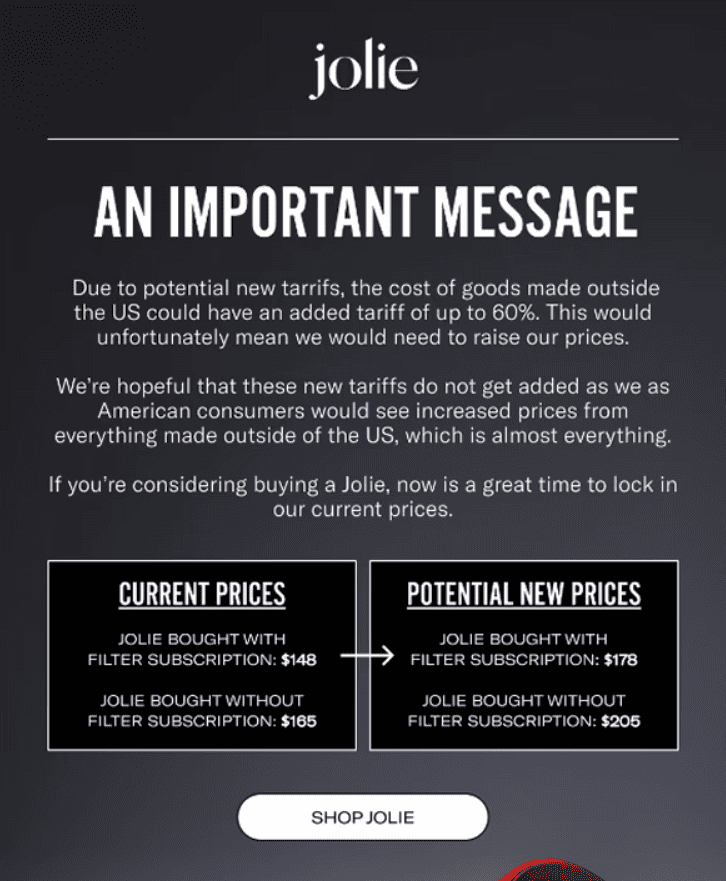
Here is a 2025 example from the ecommerce store Jolie, which used an upcoming tariff-related price increase to encourage customers to order before the change:
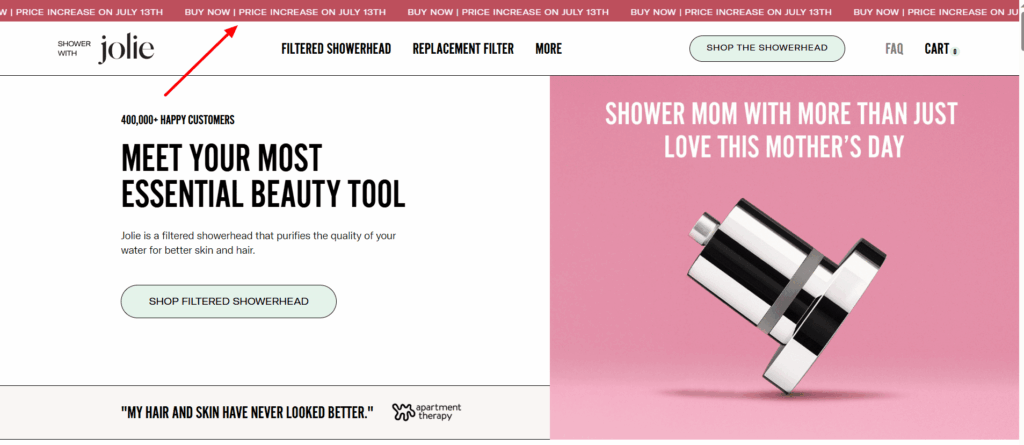
It also added a short banner at the top of the site:
You can place a similar explanation in post-purchase emails, on your FAQ page, or beside the affected product.
Keep it simple and free of drama. A short explanation can reduce confusion without turning your store into a political message.
This is also a good time to improve the offer.
Better packaging, clearer instructions, or a useful digital guide can make the product feel more complete.
Just make sure the extra value is real.
4. Sell to countries other than the US
Another option is selling outside the US.
US tariffs apply to goods entering the United States. Those same duties don't apply when a Chinese supplier ships to Canada, Australia, or Germany.
But every destination has its own VAT or GST rules. Customs and low-value import rules differ too.
Don't assume another market is duty-free.
Selling into Germany or Ireland comes with a cost the US rules don't cover. Since July 1, 2026, qualifying EU imports worth up to €150 carry a temporary €3 customs duty per tariff item. That sits on top of VAT, as a separate charge with its own rules. Here's how the €3 duty changes your numbers.
The same product may still work elsewhere, but run a new landed-cost calculation before moving your ad spend.
Some countries worth researching for dropshipping include the United Kingdom, Ireland, and Australia.
If your store uses a platform like Shopify, you can create localized storefronts and show local currencies.
The exact tax and market features depend on your plan and setup.
English-speaking countries can be simpler from a language perspective. You still need to check local payment methods and returns.
Taxes and delivery expectations matter too.
Ask your supplier for a route-specific delivery estimate before advertising. Better yet, place a test order to the country you want to target.
5. Import in bulk and warehouse in the US
Your final option is bulk importing and US-based warehousing.
Instead of fulfilling every order directly from your supplier, you import a batch into the US and store it with a domestic warehouse or fulfillment partner.
Does bulk importing reduce the tariff rate?
Not by itself. The rate still depends on the country of origin and HTSUS code.
Exemptions and other trade remedies matter too.
What you may reduce is the freight and brokerage cost per unit. Handling costs may fall too.
Lower shipping and entry costs per unit
When you import a larger shipment, fixed customs and handling charges are spread across more units.
Sea freight can also cost less per unit than sending one product at a time by air. The exact saving depends on the shipping lane and shipment size.
Your product and carrier matter too.
Faster domestic delivery
Once your inventory has cleared customs and is inside the US, you can send customer orders through a domestic carrier.
That can shorten delivery times and reduce the chance of a customs surprise at the customer's door.
The exact delivery window still depends on the warehouse, service level, and customer location.
Better control over quality and branding
With local inventory, you can inspect products before they are sent to customers.
You can also add your own packaging, thank-you cards, or bundles.
These steps are harder when a supplier sends one order at a time from overseas.
They can also help your store feel less like a generic product page and more like a real brand.
You don't need your own warehouse
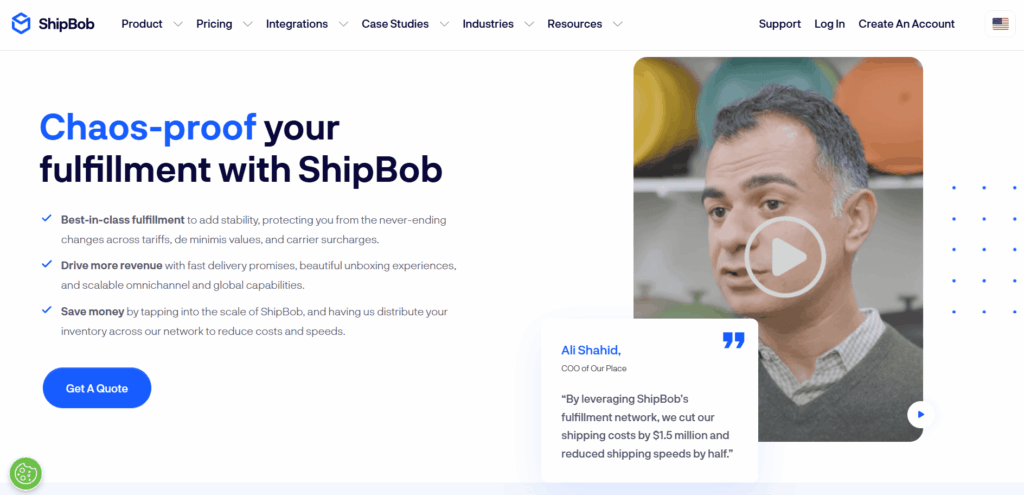
You can use a third-party logistics provider, also known as a 3PL.
Companies like ShipBob can store inventory and handle picking, packing, and shipping:
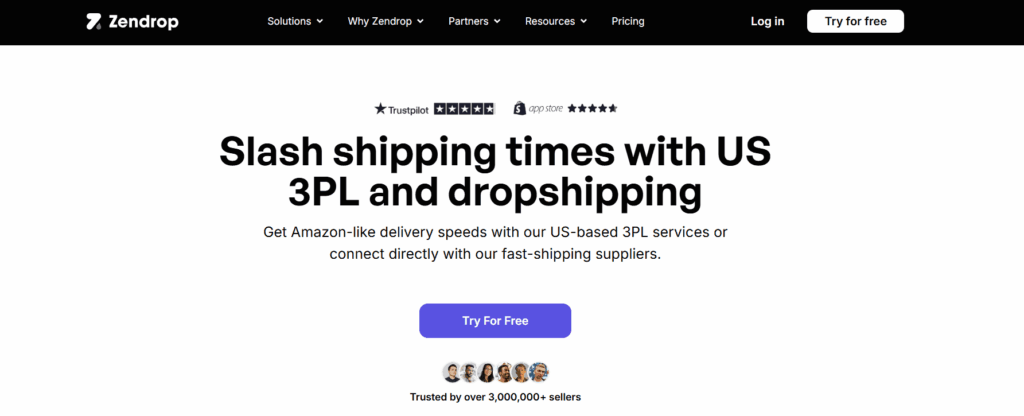
Some platforms, including Zendrop, also list products stocked in US warehouses:
You'll need more cash upfront, and you'll take on inventory risk. Only consider this model after the product has reliable sales data and you understand the full import cost.
What comes next?
The tariff system has already changed several times since 2025.
The 145% rate didn't last, and the legal basis changed as well.
On February 20, 2026, the US Supreme Court ruled that the International Emergency Economic Powers Act didn't authorize the challenged tariffs.
A temporary 10% surcharge under Section 122 then applied from February 24 and expired at 12:01 a.m. EDT on July 24, 2026.
The current Section 301 duties took effect on July 24, 2026.
So, the rate came down, but the tariff pressure didn't disappear. The legal authority and duty structure changed.
That's why you should treat today's rate as a snapshot, not a permanent operating cost.
Before scaling a product, re-check the current tariff notice and product exemptions. Check the customs-entry rules too.
The rate could change again, and your product economics would change with it.
Summary
Before we go, here is the practical summary:
- Most non-exempt Chinese-origin goods face an additional 12.5% Section 301 tariff. Normal duties and other China trade remedies may stack on top.
- The commercial $800 de minimis route is gone for imports from all countries, and the suspension is now indefinite.
- Commercial low-value shipments can no longer rely on de minimis. The required entry process depends on the value, product, and shipping channel.
- Switching the shipping country doesn't automatically change the product's origin. Rerouting a Chinese-made product can still leave China duties in place.
- Recalculate every SKU using its full landed cost, then re-check the rules before increasing ad spend.
Conclusion
The easy version of dropshipping, where you list a cheap AliExpress product and send it directly to a US customer, is far less forgiving now.
That doesn't automatically make dropshipping impossible. But you can't build your pricing around the supplier cost alone.
Before scaling a product, verify its country of origin and HTSUS code. Then check exemptions, the customs-entry method, and the full landed cost.
If the numbers don't leave room for advertising and refunds, change the product or fulfillment setup. Do that before spending more on customer acquisition.
That's the practical difference between adapting and hoping.
Want to learn more about dropshipping?
Ready to improve your dropshipping setup?
Check out the articles below:
- Dropshipping From India to the US in 2026: Is It Possible?
- How to Start a Dropshipping Business in the US (2026 Guide)
- Can You Dropship USA-Made Products in 2026? Rules & Tips
New to dropshipping? We cover what it actually takes in our guide on how to start dropshipping here.