

Is dropshipping really dead in 2026, or has the easy-looking version just gotten harder to pull off?
The fulfillment model is still around. Shopify and Amazon both still document dropshipping, and Shopify published new dropshipping guides in 2026.
But that doesn't mean every dropshipping store is a good idea.
A weak product or unreliable supplier puts the store on shaky ground, while poor margins leave little room to recover. A copy-paste offer customers find somewhere else adds another problem.
Quick Answer: Is dropshipping dead?No. Dropshipping is still an active ecommerce fulfillment method in 2026. Major ecommerce platforms still publish current guidance for using it, and US ecommerce sales were up year over year in the first quarter of 2026.What has changed is how little room there is for weak execution. A generic store with copied supplier content and poor shipping is fragile, especially when the margins only work on paper.So don't ask whether dropshipping is alive in general. Check the product and supplier first, then make sure the costs and customer experience work for the store you want to build.
Let's get started!

Start your store on Shopify
Free 3-day trial + $1/month for 3 months
- Grows with you from first test product to full brand
- Thousands of apps and hundreds of themes to customize your store
- Beginner-friendly editor with pro features when you're ready
No card to start. Cancel anytime.
Is dropshipping dead in 2026?
No.
Dropshipping is a fulfillment method where a third party stores and ships products for the seller. Major ecommerce platforms still publish current guidance for using that setup.
Shopify still has dedicated dropshipping documentation, supplier guidance, and a dropshipping section in its App Store.
Amazon also allows dropshipping under its seller rules, as long as you follow its policy and remain the seller of record.
Online retail isn't disappearing either. US Census Bureau data showed seasonally adjusted US ecommerce sales in the first quarter of 2026 were 9.8% higher than the same quarter in 2025.
That still doesn't prove a dropshipping store will make money.
Ecommerce growth tells you people are buying online. Platform support tells you the fulfillment model still exists.
Neither one tells you that your product has enough demand or that your costs leave a workable margin.
That's why we wouldn't use market-size forecasts or Google Trends alone to decide whether to start.
What does Google Trends tell us?
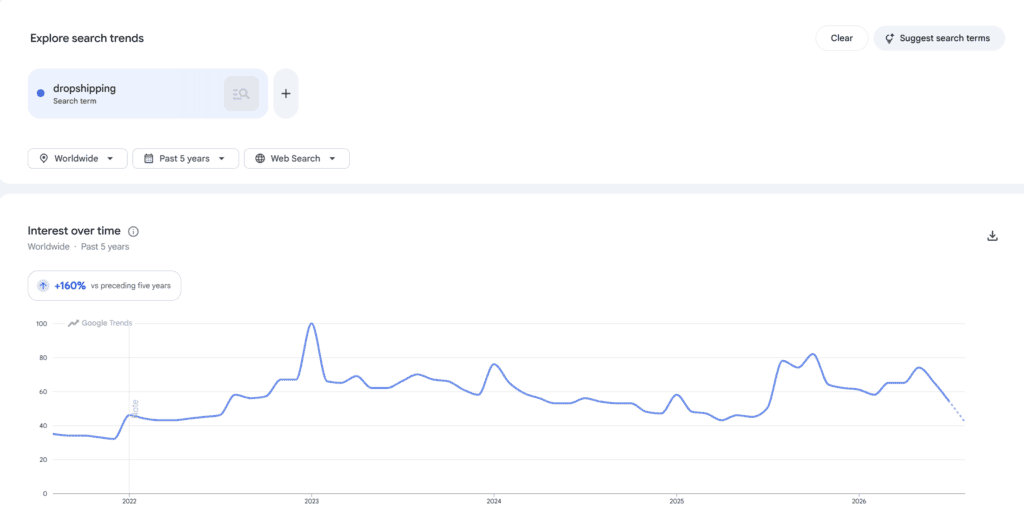
Google Trends is useful for a narrower question: are people still searching for the term "dropshipping"?
And yes, they do:
If you want the broader decision guide, our article on whether dropshipping is worth it looks at the model from that angle.
What has actually changed about dropshipping?
The fundamentals haven't suddenly changed. Product quality, shipping, margins, and customer service always mattered.
What's changed is how little room there is to ignore them. A weak setup is much easier for customers to compare with better alternatives:
| Weak shortcut | Stronger approach |
| Import the supplier's product page as-is | Build your own offer around what the customer actually needs to know |
| Choose a supplier mainly because the product is cheap | Check product quality, shipping, stock handling, and support before relying on them |
| Set the price from the supplier cost alone | Work out the full margin after the costs that apply to your store |
| Use vague shipping promises and deal with problems later | Set delivery expectations based on what the supplier consistently delivers |
| Keep testing because you've already spent money on the store | Set a limit before each test and decide what result justifies another one |
None of those fundamentals are new. The difference is that customers have fewer good reasons to tolerate a weak version of them.
Why do people say dropshipping is dead?
Usually, they're talking about one of four problems, not the fulfillment method itself.
1. Too many stores sell the same products in the same way
Finding the same product in several stores doesn't mean the product is impossible to sell.
But it does make a copied offer harder to defend. When the product page and ad look like everyone else's, customers have little reason to choose your store.

That's a product-and-offer problem, not proof that the whole model is saturated.
Our guide to dropshipping saturation goes deeper into that distinction.
2. Slow or unreliable fulfillment hurts the customer experience
Dropshipping gives you less direct control over stock and shipping because the supplier handles fulfillment.
That becomes a real problem when the supplier takes too long to process orders or sends inconsistent products.
Don't solve that with nicer shipping copy.
Check where the supplier ships from, order a sample, and compare the delivery time with what customers in your target market will accept.

Spocket and Syncee are two supplier platforms worth comparing; use our dropshipping supplier guide to explore more options.
3. Thin margins leave little room for mistakes
A product often looks profitable when you compare only the selling price with the supplier price.
Then shipping and payment processing come out of the same sale. Refunds, software, and marketing take another bite.

That's why pricing isn't about undercutting the next store by a dollar.
Start with your real costs and work out whether the price still makes sense for the customer.
Our dropshipping pricing guide and profit margin guide walk through those numbers.
4. Marketplace and platform rules matter
Dropshipping doesn't remove your responsibilities as the seller.
For example, Amazon allows dropshipping only when you follow its policy and clearly remain the seller of record.
Shopify also tells merchants to understand the legal and compliance requirements that apply to their products and business.
So a supplier being willing to ship a product doesn't automatically mean you're ready to sell it.
Check the rules for your country, sales channel, and product category before taking live orders.
Is dropshipping saturated in 2026?
Not in the simple yes-or-no way the question suggests.
Dropshipping is a fulfillment method, not a single product or market. A crowded phone-accessory offer tells you nothing about the competition for a different product sold to a different customer.
That doesn't mean you should ignore competition.
Instead of asking whether all of dropshipping is saturated, check the specific offer you're considering:
- How many stores and marketplaces already sell a similar product?
- Are they using the same supplier images and nearly identical descriptions?
- What would make your offer worth choosing at your planned price?
- Do the margins still work after realistic costs?
- Do you have a practical way to reach the customer?
Competition is useful information, but it isn't a reason to pretend every crowded product has an easy workaround.
Sometimes the better decision is a different product or niche. Sometimes it's not opening the store yet.
Tip: Want a broader overview of the model before deciding? Our dropshipping guide brings the main pieces together.
What does a stronger dropshipping setup look like in 2026?
No single store formula makes dropshipping work.
The difference shows up in a few practical areas.
1. Build the offer around the customer, not the supplier listing
Supplier content is a starting point, not a finished product page.
Use your own description and check every claim before publishing it.
Better images and clearer product information help too, especially when the supplier page leaves obvious questions unanswered.

Our guides go deeper into writing product descriptions and improving your product images.
2. Give customers reasons to trust the store
A different logo won't rescue a bad product, but the store still needs to look like a real business with clear contact details after ordering.

Make the shipping and return information easy to find. Use accurate product content and give customers a clear way to reach you when something goes wrong.
Our guide to making a dropshipping store stand out covers more ways to improve the customer-facing side.
3. Improve shipping before you promise it
Faster delivery is useful, but the real goal is a shipping promise the supplier consistently meets.
Local warehouses are one route. When the current shipping setup doesn't work for your target market, a different supplier or product is often the better fix.
You also don't have to source from China. Our guide to dropshipping with suppliers outside China explains the alternatives.
For more ways to shorten delivery, see our guide to faster delivery when dropshipping.
4. Know the numbers before you buy traffic
Marketing doesn't fix a product that loses money every time someone buys it.
Work out the product and shipping costs first, then add the fees and other expenses that apply to the order.
Once the rough numbers make sense, choose a marketing channel that fits the product and customer instead of trying everything at once.
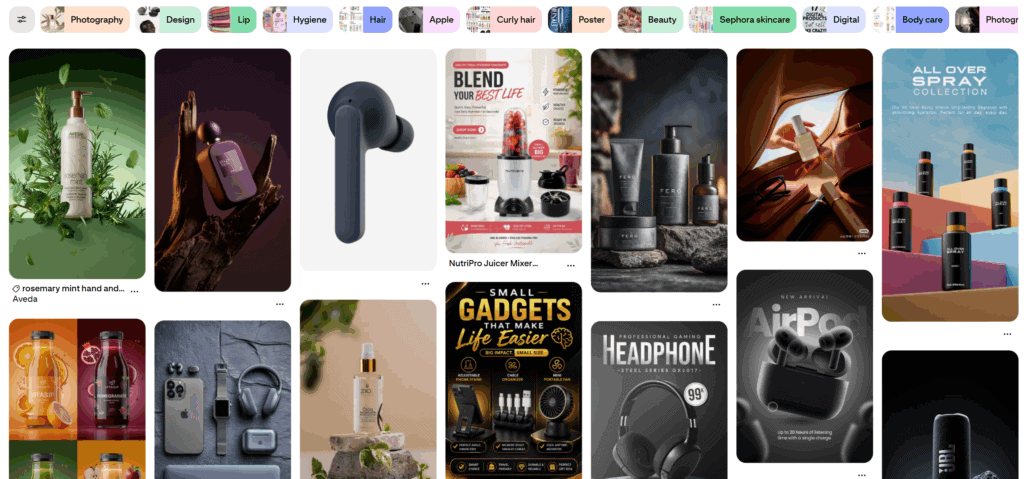
Pinterest can work for the right audience, while other products fit search or short-form video better.
Our dropshipping marketing guide helps you compare the main methods.
5. Give each test a reason and a limit
Testing isn't the same as repeatedly spending money until something works.
Before the next test, decide what you're trying to learn and what you'll change. Set a budget or time limit that fits your situation, then review the result before spending more.
From there, choose between three valid options. Test again with a specific change, change direction, or stop.
Our guide to why dropshipping stores struggle goes deeper into that decision process.
Is it too late for you to start dropshipping?
No. There's no deadline after which dropshipping suddenly stops being possible.
But "not too late" isn't the same as "you should start."
Before putting money into a store, check whether you have a product worth testing and a supplier you trust, then make sure the rough margin works and that you have a realistic way to reach the customer.
Also be clear about the money you're risking. If you need the first few sales to immediately pay your bills or fund the next order, the setup is already under pressure.
Dropshipping also isn't a shortcut to passive income. You're still running an ecommerce business.
Suppliers and customers need your attention, and so do the costs and problems that come with real orders.
If those trade-offs don't fit what you want, choosing another model is completely reasonable.
Alternatives to dropshipping
Dropshipping solves one specific problem: selling without buying and holding the inventory first.
If that trade-off doesn't fit you, compare what you want more control over:
| Alternative | Worth comparing when... |
| Print on demand | You want custom designs without holding finished stock |
| Buy inventory yourself | You want more control over stock, product checks, and packaging |
| Use a 3PL | You want to own inventory but outsource storage and shipping |
| Private label | You want more control over the product or branding and accept a larger commitment |
| Affiliate marketing | You'd rather recommend products than handle orders and customer service |
| Freelancing or services | You'd rather sell your skills than operate a product store |
For a longer comparison, see our guide to dropshipping alternatives.
So, is dropshipping dead?
No. Dropshipping is still used as an ecommerce fulfillment method in 2026.
What deserves to disappear is the idea that copying a supplier listing and adding a large markup is enough because someone called the product a winner.
The model still leaves useful room to test products without buying a large batch of inventory first. In exchange, you give up some control over stock and fulfillment.
So check the specific business rather than the label. Does the product have a reason to exist in your store?
Does the supplier meet the shipping and quality standard you need? Do the numbers still work after real costs?
If those answers hold up, a small test has a reason. If they don't, put your money toward a different product or fulfillment model instead.
And if you're still deciding whether dropshipping itself fits you, read our full dropshipping worth-it guide next.
Want to learn more about dropshipping?
Here are a few useful next steps:
- Is Dropshipping Saturated? What to Check Before You Start
- Marketing for Dropshipping: 8 Strategies and How to Choose
- Dropshipping vs. Affiliate Marketing: Which Fits You?
- Tips to Reduce Legal Risk When Dropshipping
New to dropshipping? Our guide to starting dropshipping covers the setup, from product research through your first store test.







4 Comments
Thank you. Thank you. Thank you. I just became aware of your site. It is a Godsend. Much appreciate you doing this. Blessing to you always.
Hi Dervie,
That’s a lot of thank yous! We appreciate your amazing comment and hope you learn a lot here 😊
Have a great day!
– Patryk
Exactly Patryk, it’s time to understand that competition is getting fierce in dropshipping (and everywhere else) & you need to do something better than the crowd. That’s where the most money is.
It’s a common mistake amongst beginners that they try to find proven methods & copies, which brings nothing in this competitive world.
Right from designing your unique store to offering faster delivery times, you need to look at everything to make the business work out.
This article is worth a read! Thanks, Patryk.
Hi Suresh,
Thank you for this fantastic comment. You are completely right as well!
Thanks for reading the article, and have a great rest of your day!
– Patryk