Creating, managing, and making money with your dropshipping store is hard work but fun, right?
There's no time in your day to think about legal stuff, like getting sued. After all, your business isn't big enough yet to make it worthwhile for someone to sue you.
And chances are, it's not likely you could ever do anything "bad" enough to get yourself sued, lose your business, or damage your reputation, right?
Wrong.
Quick Answer: How to not get sued dropshippingAvoid getting sued when dropshipping by registering your business as an LLC, using only licensed or original images, verifying trademarks before selling branded products, purchasing liability insurance, and working with trusted suppliers.Also, create clear return policies and provide excellent customer service to reduce legal risks.
You can be sued for a host of things, everything from using an unlicensed picture on your website to violating the 'Americans with Disabilities Act' to being accused of knowingly selling an unsafe product that causes death.
And while that sounds dreary and demotivating, the good news is that you can learn how to shield yourself by taking some time to learn a few strategies, access relevant tools, and apply the newfound knowledge.
Some will cost you some bucks, while others are free, requiring only a small investment of your time.
But all of them will inform and better prepare you to succeed in dropshipping without worrying about being sued.
The will to succeed is important, but what's more important is the will to prepare.
Bobby Knight
We already know your dropshipping store's success is important, so let's get you prepped with ways to avoid getting sued for dropshipping.
Disclaimer: We are not lawyers, and this post should not be considered legal advice. You should seek appropriate counsel for your own situation.
Also, this post is directed primarily toward readers in the United States. If you are conducting business outside the United States, it is recommended you find and understand your obligations regarding disclosure.

Start your store on Shopify
Free 3-day trial + $1/month for 3 months
- Grows with you from first test product to full brand
- Thousands of apps and hundreds of themes to customize your store
- Beginner-friendly editor with pro features when you're ready
No card to start. Cancel anytime.
1. Get a business license

Is a business license absolutely required for a dropshipping store? In a sense, no. But it is a wise idea for many reasons.
Dropshipping comes with a few risks, one of which is losing your personal property, including your house, car, and/or bank account, if you are sued and haven't obtained a business license.
With a business license, your online store is now a registered entity in its own right.
This means your personal fortunes are now protected because should someone try to sue you, all the liability rests with the business.
In the US, you have a choice of registering your business as an LLC or an S-Corp. (Other countries have similar but different options.)
An LLC consists of a one-time filing fee (from 40 - 500 USD) and, in most cases, an annual or biennial fee (from 0 to 500 USD), depending on where you live and other factors.
It's wise to consult with a local accountant, attorney, or tax advisor, not only to verify the cost but also to learn how to register your business, which will help you understand your tax responsibilities as a dropshipper.
Having this business license in hand creates a solid foundation for your business.
It declares to your customers, your suppliers, and the world that you are a credible business owner worthy of their serious attention!
2. Don't use copyrighted images or videos
Most of us are not legal whiz kids who claim to know everything there is to know about copyright law.
So, let's keep this simple.
Copyright is the right to copy!
This means that any person who has created an original work (such as pictures, images, and videos) has the exclusive right to copy, sell, publish, and otherwise distribute their work.
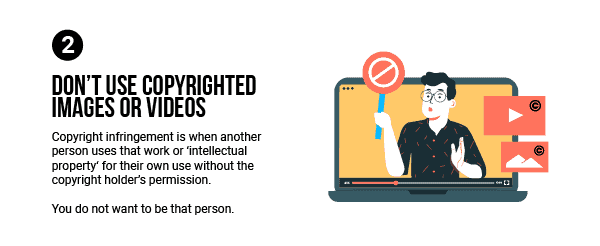
Copyright infringement is when another person uses that work or 'intellectual property' for their own use without the copyright holder's permission.
You do not want to be that person.
Copyright infringement is a serious violation of the law in the international community, including the US.
How serious? Well...
The United States federal copyright law provides that the original owner of copyrighted material can be entitled to damages worth $750 to $30,000 for every infringement. Additionally, if the copyright owner proves that infringement was intentional, you may end up paying $150,000 for every infringement.
The copyright laws aside, recent jury awards have ranged from $500,000 to $1,000,000. A good example is a Western Washington jury that awarded a copyright owner over $1,000,000 in damages for the illegal use of five images.
Source: CanISueForThat
Claiming not to know the law or thinking you won't get caught violating the law won't protect you from the severe consequences of copyright violations - getting sued!
Could your dropshipping store, or you, survive a financial hit like that?
If you're dropshipping with suppliers from China, it's essential to know that while Chinese copyright laws are slowly evolving to align more closely with international standards, many individuals and companies in China still disregard the rights of others by copying, distributing, and even selling another person's intellectual property.
Related article: Is Dropshipping Legal in 2026? Rules, Risks & Store Setup
However, this also occurs in other countries, so be sure not to sell a product from any supplier without first verifying that they are licensed to do so, as you may be held responsible.
And while Fair Use may, in some circumstances, afford you some protection for using material without the copyright holder's permission, it only applies to some forms of content.
So, how do you protect yourself from the possibility of copyright infringement?
First thing: learn about it.
Learn a bit about the copyright law
I know. It sounds like dry stuff, but all you need to do is learn a few basics.
A good place to start is with the US Copyright Office, which can teach you a lot about the basics of copyright law.

It's not as much fun as sourcing photos and videos, but the more knowledge you have, the more secure you'll feel knowing it could save you from being sued.
Next up is learning how to identify a copyrighted image.
How to identify a copyrighted image
The easiest way to determine if an image is copyrighted is to look for the copyright sign (©), which is usually embedded within the image.
If not, the copyright holder's name or website may be visible on or under the image.
Easy, right?
The reality is that very often, images and videos don't have any visible copyright ownership.
If that's the case, don't make the mistake of assuming that it's free for the taking.
Why?
Copyright holders are not legally required to show the symbol or even to register their ownership of their work.
Original work is actually automatically protected from the time of its creation until long after its creator is deceased, whether it's registered or not.
"Watermarked" images, on the other hand, are a more easily recognized example of a copyrighted image:

But if you're tempted to think, 'I'll just erase the watermark with my specialized software and use the picture anyway,' stop!
In a court of law, this action indicates your willful intention to infringe upon the copyrighted image, and you will suffer the consequences of an additional hefty fine.
So, what is an ecommerce dropshipper like you supposed to do?
If you can't identify whether an image you sourced on the search engine is copyrighted, a good rule of thumb is to assume it is.
And if you really want to use it, you will need to determine the copyright holder's name to obtain their permission.
The US Copyright website, where you did your basic training in copyright law, is also a great place to look for copyrighted items yourself or to pay a fee to have them searched for you.

However, let's explore other worry-free and free ways to obtain the images and videos you need.
After all, as a dropshipper, you know that images and videos are vital tools for marketing your products and brand.
You need images not only for the products you sell but also for random images and videos to liven up your website, blog, and social media posts.
How to find product images and videos for your dropshipping store
Without products, you don't have a store. So, let's start here.
The most logical place to begin looking for product images or videos is your supplier.
AliExpress, for instance, actually provides videos along with some of its products, which you can learn a lot about in this article.
However, as a savvy dropshipper, you won't use them without first checking with your supplier to ensure the image or video is not copyrighted.
If your supplier says that it is, your next question will be:
Can you provide me written proof that you are authorized by the copyright holder to use it?
Assuming the supplier gives you proof of authorization, file the document in a safe place because if you are ever sued, you may be required to provide that proof.
Another way to get product images is the D.I.Y. method.
It's a little bit more labor-intensive, but you can pre-order the products you want to sell from your supplier (which is a good way to check on product quality as well) and take your own product photos with a camera or cell phone.
Even if you're not convinced you can do a good job of it, there are many free and paid photo editing apps out there that will make you look like a pro.
One example is Canva.

These tools allow you to create unique and professional-looking photo images and videos without the fear of copyright infringement.
Additionally, your work will be fresh, original, and distinct from all your dropshipping competitors.
Who doesn't want that, right?
Hiring a professional photographer is also an option, but if you want to keep your costs to a minimum, using your own photos with photo editing apps is a great way to go.
How to find copyright-free images
Now, if you're looking for copyright-free photos and videos for your website, blog, or media posts, you can find thousands of them on websites like:
There you'll have access to thousands of royalty-free, open-source images and videos to choose from.

It's also really easy to locate images that are 'free to use, share, or modify, even commercially,' with Google's Advanced Image Search.
Simply enter the search terms and filters to get your desired result:

And if you're looking for an image or video, want to know its source, and/or determine its usage rights, consider using one of the many Reverse Image Search Tools, where you'll have access to even more images to use in your marketing campaigns or blog.
Again, if you really want to set yourself apart from the crowded internet space, give serious consideration to creating and using your own images that will go a long way to support your unique dropshipping store.
In the end, if you're not sure if something is copyrighted or not, don't use it until you have researched its source and received permission to use it.
Learning a bit about copyright, utilizing your creativity, and accessing a few helpful tools will go a long way in reducing the likelihood of being sued for using unlicensed copyrighted products, images, and videos.
3. Be careful when selling trademarked ® products without permission

Our next tip to avoid being sued is to be cautious of trademarked names and products.
Like copyrights, trademarked items can be identified by a symbol, in this case, by a ® or a TM, but not always.
Both copyrights and trademarks offer intellectual property protection to their holders, but differ in the assets they protect and the registration processes they use.
Most of us are familiar with the names and images of trademarked items because of their high visibility in our culture through various media.
For example, is there anyone out there who doesn't know trademarked brands like:
- Nike
- Rolex
- And things like 'Baby Yoda'

They are all easily recognized, popular, and universal brands, but 'Baby Yoda,' or 'The Child' as he's known, isn't just the adorable green character of Star Wars/Mandalorian fame; he's also a good example of the dangers of trademark infringement.
Since 2019, many online sellers have rushed to capitalize on his cuteness, selling everything from coffee cups to pajamas, but some made a fatal mistake.
They copied, cast, crocheted, and re-created his image without regard for the trademark jurisdiction held by its owner, Disney, the ultimate example of a trademarked name.
The consequences? Disney had the store owners' 'Baby Yoda' products delisted.
Disney also won a lawsuit to completely shut down an online store due to copyright and trademark infringement for stealing images that were very similar to those of Mickey Mouse and others.
So, before deciding which products to sell in your store, ensure you obtain assurance from your supplier to confirm they are genuine.
If the 'Baby Yoda' backpack is your chosen product, sell it only if you know that the licensed Disney manufacturer has authorized your supplier to sell it to you and you to your customers.
Never risk your credibility and reputation as a business owner by selling counterfeit branded items. Or you, too, could be shut down and sued.
The same rule applies here as it did for copyrights. If you're not sure if a product image or product name is trademarked, don't sell it until you've done your research.
Related article: How to Check if a Product Is Trademarked or Copyrighted
The brand owner might not like you reselling their goods without their explicit authorization, but it is not illegal.
So long as the rules below are followed, then there will be no problem with your actions, and this practice should remain legal for now:
- You didn't modify the products (they are unaltered; in their original form).
- You are not claiming to be an authorized reseller.
- You do not breach their trademarks, e.g., using their logo, banners, images, slogans, etc., without their permission. (So take your own images and write your own description of the goods, and don't use any other brand IP belonging to Nike.)
- And lastly, that the goods are permitted for sale in the jurisdiction in which you are selling them (for example, the brand owner themselves has already sold them in that region).
In a free market such as the EU and UK, individuals are perfectly entitled to buy and sell goods without the permission of brand owners.
In line with this principle in a free market system, people can walk into stores and legally purchase branded items for personal use or resale purposes.
For example, there is no law preventing me from buying genuine Nike trainers at discounted prices during the summer sale season, then listing them on eBay after I get home.
Yes, you can re-sell genuine items that you purchased in their original, unaltered form, without any alterations. However, it is not possible to re-sell any items, without prior consent from Nike Inc, that were originally sold outside the European Economic Area (EEA).
Source: Nike's copyright guidance
If all the conditions mentioned above in the bullet point list are met, then it is not illegal, and many businesses base their model on this.
Because there is equally nothing to prevent a business from buying branded goods from one party and reselling them; that is the basic model of a wholesaler!
Brand owners would like us to believe that this is illegal, so we refrain from doing it, as they prefer to control their distribution channels.
However, they cannot take action against us as long as we are not breaching these rules.
Disclaimer: I hope this will provide a starting point for your research to determine if you can sell the products you want to sell, but please remember to check your local laws.
For example, the one covered above regarding the re-selling of licensed, unmodified products may differ by country.
4. Purchase small business insurance

Another important tip is to get your business insured.
While purchasing insurance products won't prevent your dropshipping business from being sued, it can protect it from potential financial ruin if you are sued.
Ecommerce is booming, and the threats are expanding. As an online dropshipper, you are widely exposed to potential threats, including customer injury and medical costs, property damage, and cybersecurity issues, among others.
Whether you're an established dropshipper or just starting out, business insurance is essential to protect yourself against lawsuits.
I know. You don't want yet another monthly bill when you're trying to keep costs down.
I get that. But think for a moment.
Paying a monthly premium is a small price to pay compared to the cost of losing everything you own, including your reputation.
Remember our discussion about the importance of a business license? Having a business license and appropriate insurance is key to avoiding the pitfalls of doing business online.
And if you think your home insurance policy will cover you if your dropshipping business is sued, sadly, it won't.
You might think your homeowner's policy should be sufficient, but that is not always the case. According to Entrepreneur, "Most home-business owners have little or no coverage from their homeowner's policy.
Source: Avante Insurance Agency
What's more, if you file a homeowner's (or renter's) claim for losses sustained by a previously undisclosed home-based business, your insurer may refuse to cover it or cancel your policy."
It's good to know that suppliers should have their own certificate of insurance and may be willing to add your company's name as an "insured" on their policy.
Be sure to ask them. But most insurance companies will likely suggest that you purchase your own policy as well.
And because ecommerce is big business now, many online insurance companies design policy packages specifically for online sellers and dropshippers.
Layr is one such company that offers a free ecommerce insurance ebook to help you navigate the insurance needs of your business.

Most insurers will recommend general coverage first, known as a Business Owner's Policy (BOP).
This level of insurance usually includes three types of insurance, although different companies will name them differently:
- General Liability offers protection for harming another person, damaging their property, copyright infringement, and covers the legal expenses if you're sued.
- Commercial Property offers protection to your place of business, including furniture, computers, and loss of important documents.
- Business Income offers protection when your business operations are unexpectedly suspended, resulting in a loss of income.
As you grow your business, consider adding on additional coverage, depending on what makes sense for you.
Again, insurance companies often use different names for the same products, so be sure to compare them directly.
Here are some other products to consider:
- Cyber Liability and/or Data Breach
- Product Liability
- Worker's Compensation
- Business Interruption
- Suspension
- Charge-back
- Umbrella
- Cargo
- ...and more
If your budget allows, consider purchasing Cyber Liability and/or Data Breach Insurance, as well as Product Liability (if not already included in your Business Owners Policy, or BOP), from the outset.
Why buy cyber liability and/or data breach insurance?
Did you know that, according to Patchstack, approximately 30,000 websites are hacked every day?
With the increasing popularity of online marketing and ecommerce, and the accompanying rise in data breaches and cybercrime, it makes sense to be concerned about protecting the technical side of your business.
Think about the amount of confidential data, credit card information, for instance, that your business is responsible for storing.
It's not out of the realm of possibility these days that this sensitive information could be hacked.
Coverage will differ from company to company, but most insurers will cover costs that include loss of data or damage to software, network downtime, defense costs, and civil damages.
Why buy product liability insurance?
Imagine for a moment the panic you will feel when told that a customer's child has just died as a result of being strangled by the product you sold in your store.
If you find it hard to imagine, believe me. It's real and actually happened.
Not only are you devastated about a little boy's death, but you most certainly face financial ruin if you're not insured.
So, unless you're a millionaire without a conscience with a good lawyer who works for free, you will wish you had purchased product liability insurance.

If you're thinking, 'that won't happen to me,' it's important to understand that anyone can sue you at any time, for any reason, whether you're guilty or not.
Even if you didn't intentionally do harm, you'll still need the financial resources to defend yourself!
This is a brief overview of an extensive topic that is critical to you and your business.
Begin your "don't get sued when dropshipping" journey by doing some research. Compare different insurance companies, policies, and prices.
Get some quotes and make an informed decision.

Now you can focus on growing your dropshipping store with peace of mind!
Bonus: Did we mention that insurance premiums are tax-deductible? Ask your insurance agent!
5. Work with trusted suppliers

Your supplier is like your business partner!
If you were choosing a person to be your partner, you wouldn't choose just anyone.
Choose a supplier with a good reputation who is attentive to the needs of your business and open to resolving problems.
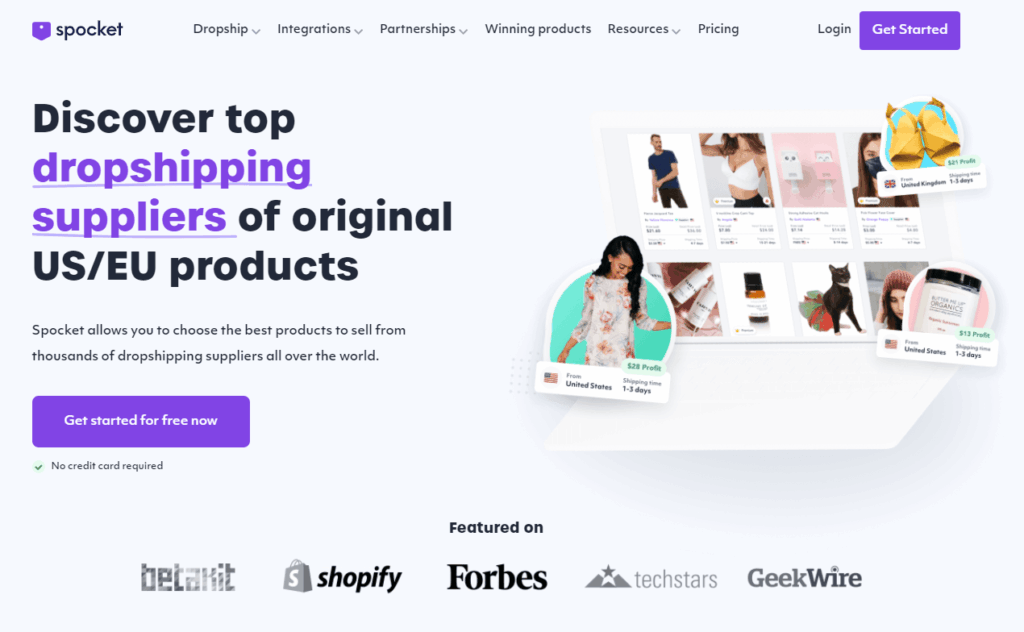
Companies like Spocket can streamline your search efforts for suppliers with the quality products you want for your store with their dropshipping app.
But regardless of where you find a supplier, be sure to ask them some pointed questions to make sure you feel comfortable doing business with them:
- Are they flexible and willing to brand your products?
- Do you have direct and timely access to them to help resolve problems?
- Are their products appropriately packaged?
- Are their shipping times reasonable and reliable?
And because product quality is key to your success, be sure to conduct thorough product analysis before making a decision.
To do that, pre-order a sample product to determine its level of quality and whether it's suited to your brand.
Some products are best avoided altogether to lessen the likelihood of legal hassles.
Pre-ordering also gives you the added benefit of seeing how long it takes the product to get shipped and delivered to your door.
Product quality and shipping times are critical to your customer, because if they are dissatisfied for any reason, it's you they'll hold responsible, not your supplier, even if it wasn't directly your fault.
So, be sure to read reviews of various suppliers and note the pros and cons of each one.
And when it comes time to sign a dropshipping agreement, read it thoroughly and make sure you are signing off on an agreement that works best for you and your business.
For more information on finding the right dropshipping suppliers for your business, check out this informative article.
6. Building customer trust is a must

That brings us to the last, but not least, tip to avoid getting sued while dropshipping.
Build trust with your customers.
It takes 20 years to build a reputation and five minutes to ruin it.
Warren Buffett
You are your business, and your business is you!
Build a likable and trustworthy business, and you'll be likable and trusted, too.
When you run your business like a professional, you lower the risk of being sued as a dropshipper!
A happy and satisfied customer has no need to think of suing you, even if their experience with you hasn't been 100%.
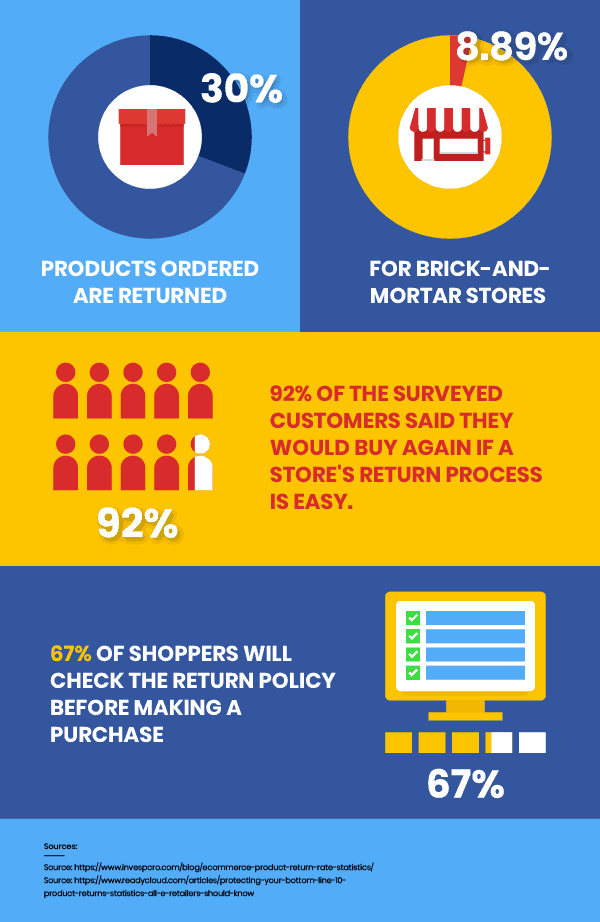
To start, ensure you have a clear and reasonable return policy. (You can find a free template here.)
Just take a look at the infographic below on why it's essential to have one:
And don't forget a shipping policy in your store. (You can find a free template here.)
Follow your own policies consistently, but consider flexibility as an ally if it means losing a customer. For more standard pages, check out this article here.
Losing one customer sale is nothing compared to the number of future customers you stand to miss out on because of an unhappy client ranting on social media.
And if dealing with difficult people doesn't come naturally to you, learn as much as you can about providing the best customer service.
It may help prevent your dropshipping business from being sued.
Your website, your blog, and your social media are your megaphones to your customer base. They should echo your commitment to providing quality products and excellent service.
To ensure your customers' loyalty and grow your business, learn as much as you can about your customers. The more you know about them, the better!
Be sure to engage customers through social media platforms like Pinterest or Facebook.
An engaged customer who likes, respects, and trusts you has no reason to be angry enough to sue you.
Tips to not getting sued when dropshipping: an overview
If that was a lot to take in, don't worry!
We have created an amazing infographic for you that you can save for later:

Conclusion
Congratulations!
Learning about the legal aspects of dropshipping isn't the most fun part of your business, but now you know how to avoid getting sued while you're dropshipping.
Implement the items mentioned, and you'll sleep better at night knowing your business investment is protected.
And with less worry, you can put your mind at ease and focus on things like growing your online dropshipping store.
You should always consult with a local legal professional to receive thorough guidance on your specific situation.
Cheers to your dropshipping success!