Are you thinking about dropshipping supplements in Europe, but not sure where to start?
You're not alone!
The hard part isn't finding a product. It's finding a supplier and fulfillment setup that work without crushing your margins or creating compliance problems.
Quick Answer: How to dropship supplements in Europe
Start by choosing the fulfillment model. Supliful is the easiest no-inventory white label option, but US shipping adds customs and EU compliance work. Nutribl offers a low-MOQ private label route through a UK 3PL. Spocket and Power Body are better suited to pre-branded supplements.Whichever route you choose, confirm the formula and label before launch. Then check the permitted claims and responsible operator. You should also verify any national notification requirements.For a long-term EU brand, stock already inside the EU is usually the cleaner setup. The trade-off is buying inventory before the customer orders.
We'll compare the supplier options first. Then we'll cover the 3PL alternative and EU rules. After that, we'll look at import costs and the simplest products to launch.
Let's begin!

Start your store on Shopify
Free 3-day trial + $1/month for 3 months
- Grows with you from first test product to full brand
- Thousands of apps and hundreds of themes to customize your store
- Beginner-friendly editor with pro features when you're ready
No card to start. Cancel anytime.
5 supplier options for a European supplement store
Your supplier affects your product cost and branding control. It also shapes delivery speed and the import process.
No supplement option below combines no-inventory fulfillment, EU stock, and full private labeling.
Four suppliers handle supplements directly. SelfNamed is a skincare add-on for a broader wellness brand:
| Supplier | Best for | Ships from | Model | Timing | Pricing | Read review |
| Supliful | Easy white label automation | US | White label dropshipping | FedEx transit is typically 3 to 5 business days after fulfillment | Free setup; Pro is $49/month; Enterprise is custom | Supliful review |
| Nutribl | Low-MOQ private label supplements | UK | Wholesale plus 3PL fulfillment | Depends on the destination and 3PL service | Prices require registration; MOQ is ten units per SKU | Nutribl review |
| Spocket | Pre-branded supplements from marketplace suppliers | Mixed marketplace | Traditional dropshipping | Usually 3 to 9 business days on the listings we found | $39.99 to $299.99/month | Spocket review |
| Power Body | Existing fitness retailers | UK and EU warehouses | Approved dropshipping program | About 2 to 6 working days across continental EU countries | Published terms state a £1,000 minimum monthly order | Power Body review |
| SelfNamed | Adding skincare to a wellness brand | EU and US | White label skincare dropshipping | Two working days of fulfillment for orders of 1 to 20 items, plus shipping | Free plan; Pro is $29/month when billed annually | SelfNamed review |
How we picked these options: We compared ship-from locations, fulfillment models, and branding. We also reviewed minimum orders, integrations, and delivery estimates. Finally, we checked pricing and recent public feedback.
1. Supliful
Best for: Sellers who want the easiest no-inventory way to launch a branded supplement.
Not for: Sellers targeting Germany or Spain, both currently missing from Supliful's destination list.
| Our Supliful rating: | 4.8 out of 5.0 |
| Niche | Supplements, beauty, and coffee |
| Products shipped from | US fulfillment centers |
| Product prices | Average |
| Product quality | High |
| Product catalog size | Medium |
| Delivery time | International FedEx transit is typically 3 to 5 business days after fulfillment |
| Main features | - White label products - No inventory requirement - Automated fulfillment on paid plans - Product mockups and label tools |
| Pricing | Free setup; Pro is $49/month; Enterprise pricing is custom |
| User reviews | Check the latest reviews on Trustpilot |
Do you want to launch a branded supplement without buying inventory first?
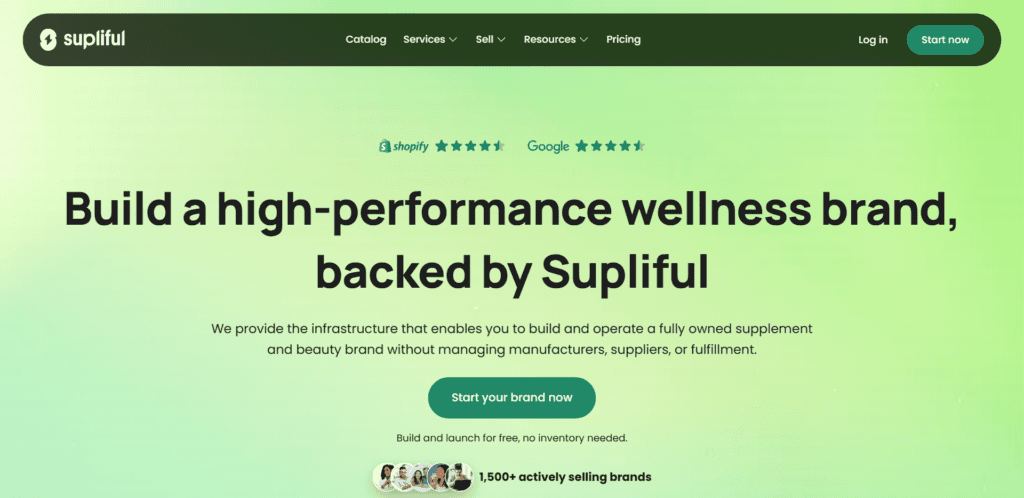
Supliful is the easiest no-inventory option on this list. You choose a ready-made product, add your label, and publish it to your store. Supliful fulfills the order after the customer buys.
For a beginner, this is the closest setup to print on demand for supplements. The downside for European sellers is the ship-from location.
Supliful ships from the US and only supports selected destinations. That makes the store setup easy, but customs and compliance take more work.
The catalog includes supplements and other white label products, such as coffee and beauty items.
Supliful also provides product information and label tools.
Still, you must check whether the final formula and label meet the rules in every EU country you target. Our supplement supplier guide explains what else to compare before you choose one.
Pros
- The easiest setup on this list. You can build branded products without negotiating with a factory or buying a large first batch.
- Useful branding tools. Supliful gives you product mockups and label customization. You can also use its design service if you need help with the final look.
- A broad catalog. You can build around supplements first, then add related products if they fit the same fitness niche or customer group.
- Flexible label styles. You can keep the design simple or build something more visual around your niche.

- Automated fulfillment. Orders can move from your store to Supliful without manual copying once you use a paid membership.
- No inventory commitment. You can test a product without placing a bulk order first.

Cons
- Shipping starts from the US. Supliful currently quotes international FedEx transit of roughly three to five business days after fulfillment. Rates for several European countries start at $20 for parcels up to one pound.

- Country coverage is limited. Check the current destination list before building your store around Supliful. Germany and Spain do not appear on its current published destination list.
- Your customer may face import charges. Supliful ships international orders under DDU terms. This means customs duties or import fees can be collected when the parcel arrives. The temporary EU duty introduced on July 1, 2026, can also apply to low-value ecommerce imports.
- US compliance is not EU compliance. A product made through US suppliers can still need changes before you sell it in the EU. Check the ingredients and label first. Then confirm the responsible operator and permitted claims.
- Read every formula. A product can fit the supplement category without matching your store's positioning. Check the sweeteners and allergens. Then review the serving size and any ingredient that may be restricted in your target market.

How do you connect Supliful to your store?
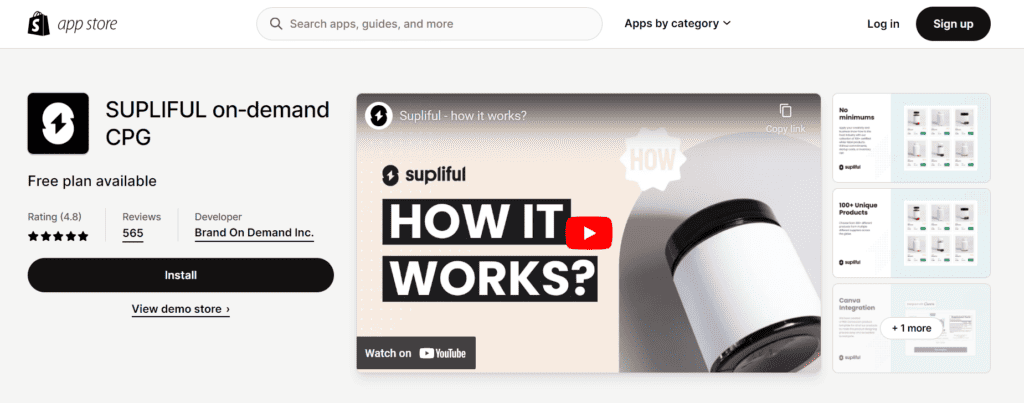
Supliful has a Shopify app, so you can connect products and orders to your store.
Pricing
You can use Supliful for free while you design products and connect one store.
The free account does not fulfill live customer orders automatically. Those orders are held until you upgrade.
The Pro membership costs $49 per month and includes automatic fulfillment. Enterprise pricing is available by request.
You can read our full Supliful pricing guide for a closer look.
Full Review: Supliful Review 2026: Pricing, Features & Honest Verdict
2. Nutribl
Best for: Sellers who want UK-made private label supplements with a low ten-unit starting order.
Not for: EU-based sellers who want to avoid the import VAT and customs paperwork that comes with UK stock.

| Our Nutribl rating: | 4.4 out of 5.0 |
| Niche | Private label supplements |
| Products shipped from | UK |
| Product prices | Available after account registration |
| Product quality | High |
| Product catalog size | Medium |
| Minimum order | Ten units per SKU for stock formulas |
| Main features | - 120+ stock formulas - Low-MOQ private label - New product development - Wholesale plus 3PL fulfillment |
| Pricing | Product, label, storage, and fulfillment costs apply |
| User reviews | See the latest feedback for Troo Health Care on Trustpilot |
Nutribl is a UK manufacturer for private label supplements.
It used to offer traditional dropshipping, but that model ended on February 1, 2025.
Nutribl now works through a wholesale and 3PL setup with a minimum order of ten units per SKU.
You still avoid running your own warehouse. But you buy a small amount of stock before the first customer order.
That puts Nutribl between pure dropshipping and traditional ecommerce. It needs more cash upfront than Supliful, but gives you more control over stock and fulfillment.

Nutribl is a trading division of Troo Health Care Ltd. That gives you an established company history to review before you sign up.

Pros
- A low starting MOQ. Ten units per SKU is small for a private label supplement order. It lets you test several products without committing to hundreds of bottles.
- Real supplement specialization. Nutribl offers more than 120 stock formulas. You can also use its new product development service when you are ready for a custom formula.
- Useful 3PL integrations. Nutribl says its fulfillment partner can connect to Shopify and Amazon. It also supports eBay and TikTok. Orders can then flow to fulfillment automatically.
- UK manufacturing. Nutribl says its stock products are made in the UK to GMP standards. It also promotes BRCGS accreditation for its manufacturing setup.

Cons
- You must buy stock first. The starting order is at least ten units per SKU, and those units stay with the 3PL partner.
- UK stock is outside the EU. EU-bound orders can create import VAT and customs charges. They can also add paperwork after Brexit.
- The final cost isn't shown as a single fee. You pay for the products and labels. Storage and picking also cost extra. The same applies to packing and shipping. Ask for the full 3PL quote before you set your retail price.
- Custom formulas need more commitment. The ten-unit MOQ applies to stock formulas. A custom product follows a different process and usually needs more time and money.
How do you connect Nutribl to your store?
You connect your sales channels through Nutribl's preferred 3PL partner.
The partner can collect orders from your store and send tracking details back after dispatch. Confirm the supported platform and exact onboarding fee before you commit.
Pricing
Nutribl does not show public product prices until you register for an account.
The starting order is ten units per SKU. You then add label design and the 3PL costs. Those can include storage, order handling, and shipping.
This is not free, but it may give you better unit economics than shipping one bottle at a time from the US.
3. Spocket
Best for: Sellers who want pre-branded supplements shipped from inside the EU without building their own label.
Not for: Sellers who need a wide, affordably priced supplement catalog to pick from.
| Our Spocket rating: | 4.2 out of 5.0 |
| Niche | General supplier marketplace |
| Products shipped from | Varies by listing |
| Product prices | Often high for supplements |
| Product quality | Varies by supplier |
| Product catalog size | Low for supplements |
| Delivery time | Usually 3 to 9 business days on the European listings we found |
| Main features | - Product importing - Order automation - Sample ordering - Branded invoicing on supported listings |
| Pricing | $39.99 / $59.99 / $99.99 / $299.99 per month |
| User reviews | Check the latest reviews on Trustpilot |
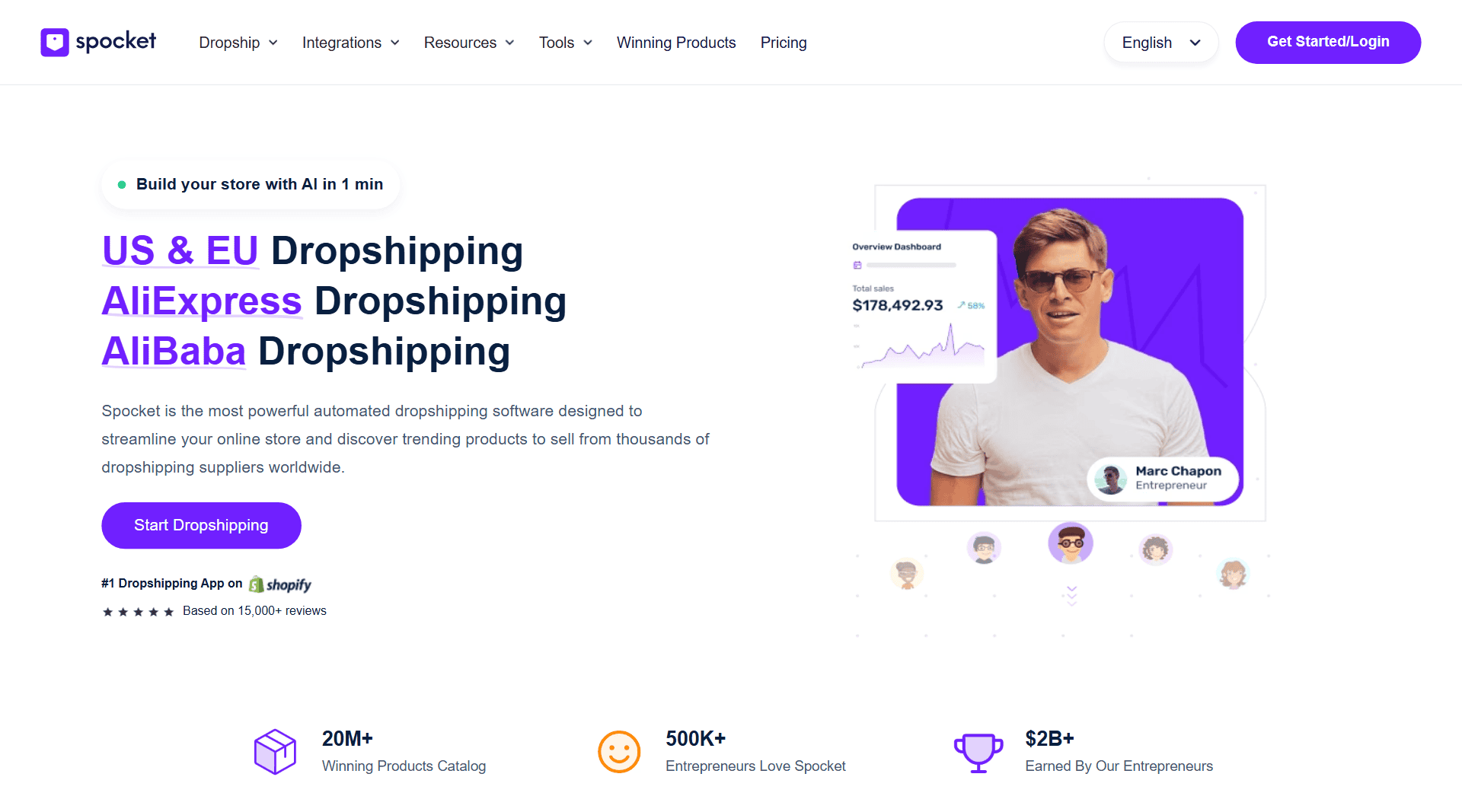
Spocket is a supplier marketplace, not a supplement manufacturer.
That means the catalog can change as suppliers add or remove products.
You can still find European listings, including supplements shipped from Spain. Many of the listings we found were connected to BigBuy.

Pros
- European listings are available. A product shipped from inside the EU can avoid the customs friction that comes with US or UK stock.
- You can test the platform first. Spocket offers a seven-day trial. Use it to check the live supplement catalog for your target country.
- Order automation is built in. You can import products and send orders to the supplier through Spocket instead of processing every sale by hand.
- Samples are easier to organize. This gives you a chance to inspect the product and delivery experience before you advertise it.
Cons
- You are usually selling someone else's brand. The supplement packaging is already finished, so this is not the right route for a true private label brand.
- The supplement selection is limited. Spocket is a general marketplace. Its supplement catalog is smaller than a specialist supplier's range.
- Listings can change. Check the exact ship-from country and delivery estimate. Then review the ingredients and current stock status for every product. Do not rely on the marketplace-level promise alone.
- Margins can be tight. The example below shows why you must compare the supplier price with the normal retail price in your target market.

How do you connect Spocket to your store?
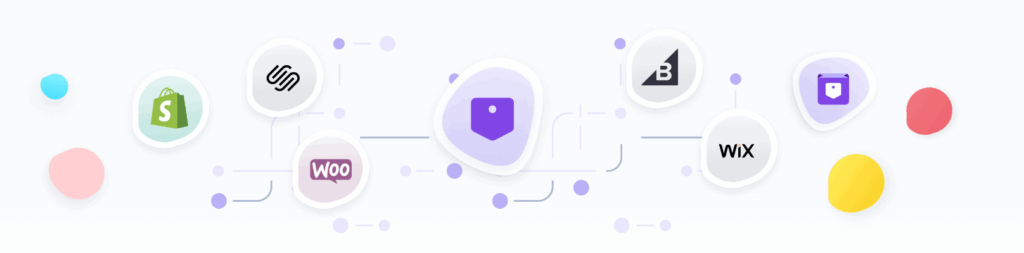
Spocket integrates with several popular ecommerce platforms. You can check its current integrations here.
Pricing
Spocket's monthly plans currently start at $39.99. The higher tiers cost $59.99, $99.99, or $299.99 per month.
A seven-day trial lets you inspect the catalog before paying for a full month.
Full Review: Spocket Review 2026: Pricing, Features & Supplier Verdict
Exclusive Spocket offer: Enter the coupon code: SpocketTrial during checkout, and you'll instantly unlock a FREE 30-day trial. Click here to redeem your free trial now!
4. Power Body
Best for: Existing fitness retailers who want an established branded-supplement catalog added to their store.
Not for: Sellers without an existing fitness store big enough to clear Power Body's £1,000 minimum monthly order.

| Our Power Body rating: | 3.1 out of 5.0 |
| Niche | Branded fitness supplements |
| Products shipped from | UK and EU warehouses |
| Product prices | Often high for a low-margin store |
| Product quality | Varies by brand |
| Product catalog size | Large |
| Delivery time | About 2 to 6 working days across continental EU countries |
| Main features | - 7,000+ branded products - Dropshipping program - API-based order setup - Branded paperwork and packaging options |
| Pricing | Published terms state a £1,000 minimum monthly order |
| User reviews | Check recent feedback on Trustpilot |
Do you already run a fitness business and want to add branded supplements?
Power Body may be worth checking. It's a supplement wholesaler with UK and EU operations, plus a dropshipping program for approved fitness retailers.

Pros
- A large branded catalog. You can sell established sports nutrition and fitness brands without negotiating with each brand separately.
- Built for fitness retailers. This is a more natural fit when supplements support an existing gym, coaching business, or fitness store.
- Branded order materials. Power Body promotes branded invoices and packaging options for dropshipping accounts.
- Relatively quick regional delivery. Power Body publishes an estimate of two to six working days across continental EU countries.

Cons
- No private label products. You sell the original brand shown on the bottle. You cannot turn the catalog into your own supplement line.

- Strict entry requirements. Power Body requires a trade account and proof of business. Its application page also asks for a professional store with at least 100 fitness products. The published terms state a £1,000 minimum monthly order.

- Margins need close checking. A wholesale discount can look fine before the extra costs arrive. Add shipping and VAT first. Then include returns and payment fees before comparing the product with local retail prices.

How do you connect Power Body to your store?
Power Body uses an API-based setup for its dropshipping service. You can read about the current program here.
Pricing
Power Body does not publish a simple monthly subscription price for its dropshipping service.
Its published terms state a £1,000 minimum monthly order. They also say you pay for the product and service. Shipping, insurance, and customs fees are separate.
5. SelfNamed
Best for: Wellness brands that want to add white label skincare beside their supplement range.
Not for: Sellers who need a supplement supplier, not a skincare and beauty catalog.

| Our SelfNamed rating: | 4.7 out of 5.0 |
| Niche | Skincare and beauty, not supplements |
| Products shipped from | EU and US |
| Product prices | Average |
| Product quality | High |
| Product catalog size | Large for skincare |
| Fulfillment time | Two working days for orders of 1 to 20 items, plus shipping |
| Main features | - 200+ ready-made formulas - No minimum order - White label branding - Local EU and US fulfillment |
| Pricing | Free plan; Pro is $29/month when billed annually |
| User reviews | Check the latest feedback on the Shopify App Store |
SelfNamed is the odd one out. It sells skincare, not supplements.
It still earns a place if you're building a wider wellness brand and want skincare beside your supplement range.
SelfNamed works like print on demand for beauty products. You choose a ready-made formula, add your branding, and let the supplier fulfill each order.

Most SelfNamed products are made in the EU, primarily in Latvia. Some are made in Italy or France. The company also uses fulfillment centers in Europe and the US.
That local fulfillment is the main reason it ranks here. You can add branded beauty products without creating another long-distance import route for EU customers.
Pros
- A large skincare catalog. SelfNamed currently offers more than 200 ready-made skincare and beauty formulas. The range covers face care and body care. It also includes hair care and makeup.
- No minimum order. You can test one product without buying a full batch.
- Local EU and US fulfillment. SelfNamed currently lists two working days of fulfillment for orders of one to 20 items. Shipping time depends on the destination.
- White label automation. You can connect your store, sync products, and send orders to fulfillment with your own branding.
Cons
- It does not solve your supplement sourcing problem. SelfNamed is useful for skincare expansion, but you still need a separate supplier for ingestible products.
- The catalog can pull your brand off course. Adding skincare only makes sense when the same customer would reasonably buy both product lines.
- Product and shipping costs vary. Check the landed cost for your target country before you build a large beauty range.
- You still control your marketing claims. Do not copy aggressive cosmetic claims into ads without checking what you can support in the market you target.
How do you connect SelfNamed to your store?
SelfNamed connects to Shopify and WooCommerce. It also supports Squarespace and Wix. You can import products and send orders to fulfillment through the integration.

Pricing
SelfNamed has a free plan. Its Pro plan is currently advertised at $29 per month when billed annually. You still pay for each product and shipment.
Prices vary by formula and packaging, so compare your full landed cost with realistic retail prices before you publish a product.
Which option fits you?
Choose Supliful if avoiding inventory matters most. Choose Nutribl when you're ready to buy a small batch and want more private label control.
Spocket and Power Body suit pre-branded products. SelfNamed only makes sense as a skincare extension.
That leaves one bigger decision: do you keep inventory at zero, or buy a small batch and use a 3PL?
Should you dropship supplements or use a 3PL?
Keeping inventory at zero makes testing easier. Buying a small batch usually gives you more control over delivery and margins.
The challenge with no-inventory dropshipping
- The strongest no-inventory automation on this list comes from outside the EU. That can add import VAT, customs duties, and customer support problems.
- Local suppliers often use a different model. Nutribl now asks you to buy at least ten units per SKU and place them with a 3PL.
- Pre-branded products limit your control. Spocket and Power Body can be easier to source, but another company's brand stays on the bottle.
- Margins can disappear quickly. Your retail price has to cover the product and shipping. It also has to cover VAT and payment fees. Returns and compliance work belong in the calculation too.
So, what is the alternative?
Buy a small amount of inventory and let a 3PL handle fulfillment.
Ecommerce: Buying inventory and using a 3PL
The traditional ecommerce approach works like this:
- Find a supplement manufacturer. Choose a stock formula or develop a private label product. A low MOQ gives you a safer place to start.
- Send the stock to a 3PL. The 3PL stores your products and prepares each customer order.

- Connect your store. Orders move to the 3PL automatically, and tracking returns to your sales channel.
- Reorder before stock runs out. You control the inventory level and can expand only after a product proves itself.
This model needs more cash upfront, but it can still be a strong alternative to dropshipping.
- You control the stock. You can inspect batches, plan returns, and avoid relying on a supplier's live catalog for every sale.
- Your shipping is easier to predict. Stock inside the EU can reach customers without a fresh import process on every order.
- Your margins can improve. Buying several units usually lowers the unit cost. The gain must still cover storage and fulfillment fees.
- Your brand has more room to grow. Manufacturers can offer better packaging or custom formulas once your order volume increases.
My view is simple: no-inventory dropshipping can work for testing when the supplier and target market fit cleanly.
For a brand you plan to scale, a low-MOQ 3PL setup is usually the stronger long-term model.
If you need help finding a European manufacturer, Wonnda is one platform you can use to compare private label suppliers.

Do not choose a manufacturer from its product photos alone. Ask for the MOQ and lead time first. Then confirm the certificates, label support, and full delivery cost.
Tip: If you want the full store setup process, read our guide on how to start dropshipping.
Whichever model you choose, the product rules stay the same.
Before you launch, you need to know who is responsible and what must appear on the label.
EU supplement rules you must follow before selling
Yes, you can legally dropship supplements into EU countries.
Your fulfillment model only changes how the order reaches the customer.
A supplement is still food, so the same product rules apply whether you hold the stock or ask a supplier to ship it.
Please note: This is general regulatory information, not legal advice. Supplement rules can change, and national requirements differ. Verify the current rules for every country you target and get specialist advice for the exact products you plan to sell.
The responsible business depends on whose name is on the product
The EU's General Food Law places food safety duties on businesses in the supply chain.
Under the Food Information to Consumers Regulation (EU) 1169/2011, the operator under whose name the food is marketed is responsible for its food information.
If that operator is not established in the EU, the EU importer takes that role.
This does not mean everyone else in the supply chain has no responsibility. Suppliers and distributors still have duties for the parts they control.
In plain English: decide who the EU-established responsible party is before the first product goes live. Do not assume the factory has handled it for you.
A non-EU supplier does not make the product EU-compliant
This matters most when you use a supplier like Supliful that ships from the US.
A product can meet US manufacturing rules and still fail an EU ingredient, label, or claims check.
The Food Supplements Directive (2002/46/EC) sets the EU framework for food supplements. National rules then add another layer.
Before you sell a US product into the EU, confirm the responsible operator and formula. Then check the label language and market notification process.
Some countries require a notification before sale
There is no single EU-wide supplement registration that clears a product for every Member State.
European Commission guidance explains that EU countries may require a notification when a supplement is placed on their market.
In France, the process runs through Compl'Alim. Italy uses its own Ministry of Health process and supplement register. Other markets may ask for different documents.
Check the competent authority for every country you plan to target. Do this before you spend money translating ads or labels.
Most mandatory food information must appear before checkout
For online sales, most mandatory food information must be available before the customer completes the purchase.
All mandatory information must also be available when the product is delivered.
That usually includes the product name and ingredients. You also need the allergens and net quantity. Add the responsible operator and nutrition information where required.
Food supplements also need specific information.
This includes the recommended daily portion, a warning not to exceed it, and a statement that supplements do not replace a varied diet. Products should also carry the required storage warning for children.
Build the product page from the final approved label. Do not treat the label as something you fix after the store is finished.
Under Regulation (EC) 1924/2006, nutrition and health claims must follow the conditions in the official EU Register of nutrition and health claims.
You cannot say a food supplement prevents, treats, or cures a disease.
This rule applies to the product page and your ads. It also covers influencer scripts, email copy, and social posts. A supplier-provided marketing line is not automatically safe to reuse.
Check whether an ingredient is a novel food
Some trendy ingredients create more work than the basic vitamins and minerals.
Under the Novel Foods Regulation (EU) 2015/2283, a food without significant consumption in the EU before May 15, 1997 may need authorization before sale.
Certain extracts, botanicals, and CBD products can fall into this category.
Check the EU novel food resources before listing an unfamiliar ingredient. The catalog is a starting point, not a substitute for product-specific advice.

Maximum vitamin and mineral levels can differ by country
The Food Supplements Directive harmonizes which vitamin and mineral sources can be used.
It does not create one complete EU-wide set of maximum amounts for every supplement.
A dose accepted in one country can create a problem in another. Check each target market separately, especially for high-dose formulas.
Great Britain follows a separate regime
This matters when you work with a UK supplier such as Nutribl or Power Body.
Great Britain has its own food supplement, claims, and novel food framework after Brexit. Northern Ireland can follow a different route for some food rules.
According to UK government guidance, the importer is responsible for the supplement's composition and safety. The importer is also responsible for its labeling.
A product prepared for Great Britain is not automatically cleared for sale in the EU. Treat them as separate markets.
Once the product itself is compliant, you still need to price the order correctly.
That starts with knowing whether the stock is already inside the EU.
How VAT and import costs work when you sell supplements across the EU
VAT and import costs become easier once you separate two situations.
Situation 1: The goods are already inside the EU
A €10,000 threshold can apply to certain cross-border B2C sales when your business is established in only one EU country and the goods move between EU Member States.
Below that threshold, you may be able to charge the VAT rate of your home country.
Once you pass the threshold, VAT is generally due at the customer's local rate.
The One Stop Shop (OSS) lets eligible sellers report that cross-border VAT through one return instead of registering separately in every country.

The €10,000 rule is not a universal exemption for every ecommerce business.
It does not apply in the same way when the stock is imported from the US or UK. It can also work differently when you hold stock in more than one EU country.
Situation 2: The parcel is imported from outside the EU
For distance sales of imported goods worth up to €150, the Import One Stop Shop can simplify how import VAT is collected and reported.
IOSS does not make the import tax-free. It lets the VAT be collected during checkout instead of surprising the customer at delivery.
There is also a new customs cost to include.
Since July 1, 2026, qualifying low-value ecommerce consignments worth up to €150 have faced a temporary €3 customs duty per tariff item. The rule is scheduled to run until July 1, 2028.
The charge is based on tariff classification, not the number of physical units. Five identical bottles under one classification can count as one item. Two differently classified products can count as two.
Our EU VAT guide breaks down the €3 EU customs duty with the Commission's worked examples.
The declarant is generally responsible for paying the duty. That may be the seller or importer. It may also be the IOSS holder or a representative.
You can read the European Commission guidance on the temporary €3 duty here.
For consignments above €150, normal import VAT and customs duties apply based on the product classification and origin.
The delivery terms matter too. A DDU shipment can leave your customer paying the charges at the door. That is a common reason for refused parcels and refund requests.
Before you set a retail price, calculate the product cost and outbound shipping.
Then add VAT and customs duty. Include payment fees and the expected return cost too. Our profit margin guide can help with the rest of the calculation.
A tax professional is worth the fee once you sell across several countries or hold inventory in more than one place.
Cost is only half the product decision. The formula can make compliance easier or harder too.
Which supplements should you dropship in Europe?
No supplement category is risk-free.
But simpler formulas give a beginner a cleaner starting point.
Simpler starting points
- Basic vitamins and minerals. The regulatory framework is well established, and the formulas are often easier to assess. You still need to check the permitted source and the national maximum level.
- Protein and sports nutrition. These products can fit a focused fitness audience and support repeat purchases. Check allergens, sweeteners, and claims carefully.
- Simple collagen products. Collagen can fit a beauty or wellness position, but the source and marketing claims still need review.
- Straightforward single-ingredient products. A short formula is often easier to assess than a blend with ten unfamiliar extracts.
Products that need more caution
CBD and unfamiliar botanicals create more compliance risk. The same applies to high-dose formulas or products marketed around a medical condition.
Complex blends can also make it harder to check whether every ingredient and dose is accepted in the target country.
Trying to launch a large pan-EU catalog on day one creates more labels and notifications. It also creates more tax questions.
For a first launch, keep the formula simple and the country list short. Expand after the product proves itself.
6 Tips for dropshipping supplements in Europe
Here are the six checks I would complete before spending heavily on ads.
1. Start with one target country
The EU is one market in some areas, but supplement notifications can still differ by country. Dose limits and language rules can differ too.
Choose one target market first. Finish the compliance work there before you copy the same store into five languages.
2. Order samples and ask for the documents
A sample tells you how the bottle looks, how long delivery takes, and whether the packaging feels professional.
You should also ask for the ingredient specification and allergen details. Then request the batch documentation and any certificate that supports the supplier's quality claims.
A GMP logo is useful, but it does not replace a product-level check.

3. Calculate the landed cost
The supplier price is only the first number.
Add shipping and VAT to the product cost. Then include customs and payment fees. Add refunds and the monthly platform cost too. Compare the result with the real retail price in your market.
If the margin only works when every customer buys two bottles, the product is probably too fragile for a beginner store.
4. Keep your health claims boring
Aggressive health copy can get clicks, but it can also create regulatory and payment problems.
Use only claims that are authorized for the ingredient and dose. Give influencers the approved wording instead of letting them improvise a medical promise.
5. Localize the label and product page
If you target France, the product information must work for a French customer.
A translated headline is not enough. Check the mandatory language and units. Then review the warnings, support emails, and returns process.
Your product page should match the final label instead of using a loose supplier description.
Influencer marketing can work well for fitness and wellness products.
Ask influencers to discuss the taste, packaging, or how they use the product. Do not let them promise that the supplement cures a condition or guarantees a body transformation.
You should also collect product reviews and show how you handle questions. That helps you build trust without making a health claim you cannot support.
Dropshipping supplements in Europe FAQs
Still have questions? These are the four points to settle before you launch.
Is it legal to dropship supplements in the EU?
Yes. The dropshipping model is legal, but the supplement still has to meet EU and national food rules. Confirm the responsible operator and ingredients. Then check the label, claims, and any notification required in the country where you sell.
Can you use Supliful for EU customers?
Yes, but only in the European destinations Supliful currently supports. Orders ship from the US under DDU terms. Customers may therefore face import VAT and customs duties. Handling fees are also possible. You still need to check EU compliance.
Do you have to notify every EU country?
Not every country uses the same process, but EU Member States may require a national notification before sale. Check the competent authority for each target country instead of assuming one registration covers the whole EU.
How do VAT and customs work for supplement orders?
Goods already inside the EU can use the OSS rules for eligible cross-border sales. Eligible distance sales of imported goods worth up to €150 can use IOSS for VAT. Since July 1, 2026, qualifying low-value ecommerce imports can also face a temporary €3 customs duty per tariff item, based on classification rather than quantity.
Conclusion
Dropshipping supplements in Europe is possible.
Supliful gives you the easiest no-inventory route on this list. Stock already inside the EU usually gives you more predictable delivery and costs.
If I were starting from scratch, I would launch one simple product in one country. After the product proved itself, I would move toward low-MOQ stock and a European 3PL.
Whichever route you choose, settle the responsible operator and final label before launch. Then calculate the landed cost before you spend heavily on ads.
Let us know if you have any questions!
Want to learn more about dropshipping?
These guides cover the next steps:
- Supplement Dropshipping: A Beginner's Guide for 2026
- How to Start a Dropshipping Store in Europe (2026 Guide)
- The 12 Best Dropshipping Suppliers in Europe (Free & Paid)
For the full beginner roadmap, read our guide on how to start dropshipping.