

Getting free traffic is the dream of every dropshipping store owner, but not every dropshipping store is SEO-Optimized.
SEO (Search Engine Optimization) can increase your revenue, sales, and conversions, and make you an authoritative brand in your niche.
According to Semrush, 37.5% of all traffic to ecommerce sites comes from SEO (Search Engine Optimization).
The best thing about SEO is that it's a constant source of traffic without paying a single dime.
So, let's start with 7 ways to increase your organic traffic for your dropshipping store!

Start your store on Shopify
Free 3-day trial + $1/month for 3 months
- Grows with you from first test product to full brand
- Thousands of apps and hundreds of themes to customize your store
- Beginner-friendly editor with pro features when you're ready
No card to start. Cancel anytime.
What is ecommerce SEO? Is it important for your dropshipping store?
Well, ecommerce SEO, or SEO in general, has the same definition and user intent.
Search engine optimization (SEO) is the process of generating more organic (i.e., free, natural) traffic from sites like Google, Bing, and Yahoo.
Implementing proper SEO techniques can make your website reputable and authoritative in your niche and increase brand loyalty.
Let's take a look at who shows up when you search Google for any product or service.
For this example, we will take men's hoodies.

As you can see, many websites rank for the keywords 'men's hoodies'.
Implementing SEO results in your page to be searched and ranked in search engines like Google, Yahoo, Bing, etc.
SEO plays an essential role, as research shows that 89% of consumers surveyed use search engines to make purchasing decisions.
So, if you ask me, I'd say SEO is as important as marketing in the long term.
1. Keyword research
The first step to implementing SEO in your dropshipping store is identifying the keywords you want to rank for.
Now, for example, everyone who has a clothing store can't rank 1st for the keywords 'men's hoodies', right?
That's where keyword research comes in.
Keyword research is the process by which you research popular search terms people type into search engines like Google and include them strategically in your content so that your content appears higher on a search engine results page.
You can find keywords people are typing into Google and rank for them with some basic tricks or free tools like Ubersuggest.
You can use Google to find related and long-tail keywords with the Keywords Everywhere Chrome extension.

Also, you can target these keywords in order to eliminate competition, as a long-tail keyword has way less competition than a normal keyword.
A longer keyword attracts fewer search queries and less traffic, but offers higher conversions.
Strategically including keywords in your product description can help Google index your pages faster, as it contains keywords people are searching for on Google.
You can also use Ubersuggest if you have some experience with SEO, because Ubersuggest can be a bit overwhelming, but it is a great tool.
Just go to Ubersuggest, type in your keyword, and click "Keyword ideas".
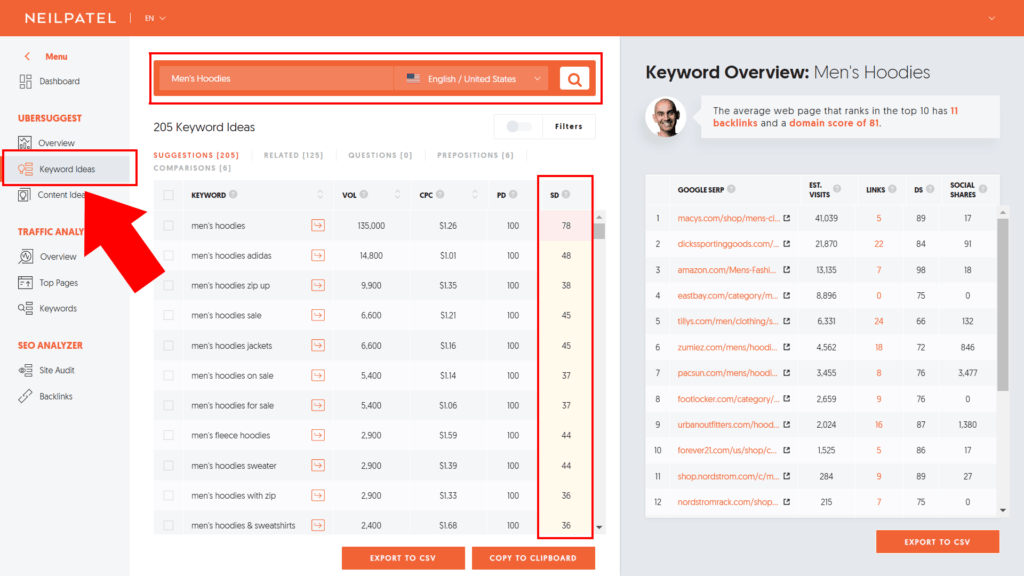
I personally target keywords that have an SD (Search Difficulty) of less than 25.
As you can see, the SD for the keywords 'men's hoodies' is 75, and I'm 99% sure that as a startup ecommerce store, you cannot rank (Top 10) for the keywords 'men's hoodies'.
If you are just beginning, I highly suggest you read the full in-depth keyword research guide from Backlinko.
2. Competitors' keyword research
Knowing what keywords your competitors are ranking for is important.
If your competitors are putting in effort to rank for those keywords, there must be something you are missing.
Competitors' keyword research is relatively easy, as you can do this with any tool, such as Moz or Ubersuggest.
We can start our competitor's keyword research by going to Moz Domain Analysis and typing your website domain.
If you scroll down to the bottom, you'll be able to find Top Search Competitors:

Now, if your top search competitor is too big, like in my case, Shopify, AliExpress, Oberlo, and BigCommerce, then you don't have to research them, at least not when you are starting out.
But you can go with smaller competitors and put their domains into Moz Domain Analysis, then you can find their competitors (because you'd all have the same niche).
Once you have at least five competitors in your niche, go to Ubersuggest and type their domain into Ubersuggest.

You can now see all the keywords that they are ranking for and have an idea of what works in your niche and what does not.
If you want to learn more about competitors' keyword research, I highly recommend this Wordstream article.
3. Website speed
Believe it or not, but website speed indirectly affects SEO negatively, and that's the last thing you want when starting out, right?

A slow website means a higher bounce rate.
When visitors visit a website and it takes more than 3-4 seconds, your bounce rate can reach 90%, according to Google/SOASTA research.
Let's be real: no one wants to wait more than 2 seconds for a website to load.
Website speed is what interests your customers.
If it takes forever to load, you've already lost half of the potential customer's interest, and that's not a good start.
Here's how to ensure your website is at its top speed:
- Check your website speed using Google Page Speed Insights, Pingdom, and GTMetrix. Find out the results and problems with your website
- Use AMP Pages (Accelerated Mobile Pages) that load within 0.5 secs (but do your research if you want AMP or not)
- Compress Images
- Use a fast and responsive WordPress/Shopify theme.
These are just the basics you should use on any WordPress/Shopify website to improve page speed.
You can read how to score a perfect 100% on Google Speed Test to learn more.
Or you can read my other article here that contains 7 ways to increase the speed of your Shopify store (Shopify Speed Optimization).
4. Website structure
Ecommerce website structure is an important aspect of SEO.
It not only helps search engines to find all the pages, but it also makes the website user-friendly.
A proper website structure will also optimize your website's speed, as it requires fewer lines of code.
And Google, or other search engine bots, can easily navigate through your website and index it quickly.
A great example of proper ecommerce website structure is:

Ecommerce websites tend to have more pages than classic websites, and if you don't have a proper structure from the start, you'll easily get lost in the future.
A great way to implement this structure on your website is to remember that almost 99% of your pages should be three clicks away from the homepage.
Also, if you already have pages live on Google and want to categorize them properly, make sure your old URLs are 301 redirects to the new URLs, or you'll lose ranking or Domain/Page authority.
5. On-page SEO
Now that you've done your keyword & competitors' keyword research, it's time to use those keywords on your page.
On-page SEO is the process of optimizing each page for search engines.

Here are a few tips on how to do on-page SEO with the keywords you found.
- Place the keywords you found in the Title, Sub-headers, Meta Descriptions, Image Alt Tags, Descriptions & URL.
- Write at least a 1,000-word product description and include the applicable keywords in it, but avoid unnecessary keyword stuffing, which Google may find suspicious.
- Your product page should include all the information, such as Shipping, Returns, Terms of Service, etc.
- Use influential words to increase CTR.
You can use a tool like ConvertMate to optimize your product pages for SEO:

It is a Shopify app that's specifically designed to increase organic traffic to your product pages.
ConvertMate generates SEO-friendly product titles, product descriptions, meta titles, meta descriptions, and URL handles for you.
The result?
As claimed by ConvertMate, you can expect at least an 84% increase in organic traffic after using the app for three months!

6. Content marketing
Now, I think content marketing is one of the most crucial parts of SEO for ecommerce.
Content marketing will provide a steady stream of organic traffic, helping you build a connection with your audience.
SEO and Content marketing both go hand in hand.
Both are required to start ranking on search engines.
Content marketing for ecommerce stores contains three steps:
- Keyword research
- Creating content around your products' niche
- Content marketing
Now that the keyword research is complete, two steps remain.
Tip: If you're using free traffic because your ad budget is tight, also check our guide to free ad credits for marketing. You may be able to test platforms like Google, Pinterest, TikTok, Snapchat, Reddit, or Amazon Ads with a starter credit before paying fully out of pocket.
1. Creating content around your product's niche
Creating a blog around your products or your niche, in general, can really help you get organic traffic & boost your conversions.
When people are looking to purchase a product, they always start by searching for it on Google.
When you have a lot of content around that product or niche, chances are your website will start ranking for those audiences.
Once people land on your blog and read about the product, how it helps, and so on, the chances of those visitors converting into customers are high because you just provided them with some free value.
You can start by writing a 600-800-word blog every week and use the skyscraper technique as you go on.
A great example is Petsmart.

2. Content Marketing
Once you've started writing awesome content, it's time to market it to the relevant audience.
SEO takes time.
You can't write one article and expect 1000s of people to be reading that article on the same day or even month.
To start getting some traction, you can market your content personally by joining communities on Reddit and Facebook.
Let's say you have a Pet product.
Once you write some blogs around that niche, you can join pet communities on, for example, Reddit.

Or you can join Pet groups on Facebook.

You can share your blogs with those communities every once in a while.
Now don't spam them with your content as soon as you join them, but take some time to connect with users, and then you can share your content.
Doing this will help you gain some traction right away.
7. Link Building

Link building is one of the major factors that directly affect SEO and determine your rankings.
For search engines, links are votes that your website has good content, and the more links, the higher your DA (domain authority) and rankings.
But link building, too, has its gray areas, and using Black/Grey Hat techniques can lead to Google penalizing you.
Here are some of the White Hat techniques you can use:
- Guest blogging
- Broken link building
- Content marketing with emails
Link building is a chapter on its own, and if you are interested in learning more, I would suggest you check out this article shared by Moz.
Conclusion
So, those are the 7 ways to do SEO for your dropshipping store.
Doing SEO at the start can be a bit overwhelming.
And sure, you can hire agencies to do it for you, but doing it yourself at the beginning will give you an idea of the ins and outs of SEO.
So, in the future, if you hire an agency, you'll know what results they've delivered and whether they are doing the right kind of SEO.
There are many agencies out there that do black-hat SEO, which can lead to Google penalizing you in the future.
Making SEO your priority from the start will yield great results in the future, so you don't have to focus solely on paid advertising.
I hope this guide was helpful, and good luck getting free traffic to your dropshipping store!
If you want to learn more ways to get free traffic to your dropshipping store, then I suggest reading this article here.
Want to learn more about dropshipping?
Ready to drive more free traffic to your dropshipping store? Check out these articles next:








8 Comments
Great post about SEO
Hi, that’s great to hear! I wish you the best!
Amazing ! I have never studied such glorious articles , consistently get more and more interesting. I want to thank you for this course
Hi Siddiq,
Awesome to hear that! And thank you for your comment 😊
Good luck with everything!
– Patryk
It helps a lot , thank you!!!
Hi Mouad,
Thank you for your comment! That’s great to hear 😊
Good luck with everything, and don’t forget that you can always contact us if you have any questions!
– Richard
Thank you for the content, it gives me the steps to start with dropshipping .
Hi Ami,
Thank you for your amazing comment! That is great to hear 😊
Good luck with everything!
– Richard