Shipping delays, wrong items, missing tracking numbers: your customers don't care that it's your supplier's fault. They're emailing you.
If you're running a dropshipping store, you already know customer support can either save your business or slowly drain it.
And if you're still copy-pasting replies from a Google Doc or running everything from one Gmail inbox, you're going to hit a wall fast.
That wall is expensive. According to Zendesk's CX Trends report, 63% of consumers will switch to a competitor after just one bad experience.
The good news? There are tools built specifically to handle the support chaos that comes with dropshipping.
The bad news? Not all of them are worth your money.
So in this guide, we'll break down the best customer support tools for dropshipping stores in 2026, what they do, who they're for, and which ones are not worth it.
Best Customer Support Tools for Dropshipping Shortlist
Here's our shortlist of the top customer support tools for dropshipping in 2026:
- Best for AI Helpdesk: Gorgias - Centralizes customer messages and uses an AI Agent to resolve repetitive tickets with real-time order data.
- Best for Pre-Sale Live Chat: Tidio - Answers pre-sale product, shipping, and returns questions through live chat and its Lyro AI chatbot.
- Best for Social DM Automation: Manychat - Automates DMs and comments across Instagram, Messenger, WhatsApp, and TikTok to handle social customer conversations.
- Best for Returns and Exchanges: Loop Returns - Gives customers a self-serve portal for returns and exchanges, with shipping labels and built-in fraud prevention.
- Best for Automated Chargebacks: Chargeflow - Builds and submits chargeback evidence automatically, helping stores recover revenue from disputes.
- Best for Support Request Forms: Jotform - Collects return, complaint, and order-issue details through customizable support forms, reducing back-and-forth.
- Best for Customer Feedback Surveys: Zigpoll - Collects feedback on-site, post-purchase, by email, and by SMS, then turns responses into AI-generated insights.
Let's get into it!
Start your store on Shopify
Free 3-day trial + $1/month for 3 months
- Grows with you from first test product to full brand
- Thousands of apps and hundreds of themes to customize your store
- Beginner-friendly editor with pro features when you're ready
No card to start. Cancel anytime.

The best customer support tools for dropshipping: An overview
Here's how they compare side by side:
| App | Best for | Price per month | Review |
| Gorgias | Helpdesk | $10 / $50 / $300 / $750 | Gorgias review |
| Tidio | Live chat and chatbot | Free / $24.17 / $49.17 | Tidio review |
| Manychat | Social media conversations | Free / $15 / Custom | Manychat review |
| Loop Returns | Returns and exchanges | $155 / $272 | Loop Returns review |
| Chargeflow | Chargebacks | 25% of the recovered amount | Chargeflow review |
| Jotform | Forms | Free / $39 / $49 / $129 | Jotform review |
| Zigpoll | Surveys | Free / $39 / $129 / $259 | Zigpoll review |
Prices are pulled from each tool's pricing page and checked on the date below. Plans change often, so confirm the current cost before you commit.
How to choose a customer support tool for dropshipping
Before a customer buys, they want a fast answer to a sizing or shipping question.
That's a job for live chat or a chatbot.
After they order, they want to know where their package is.
That's where a helpdesk and order-tracking replies do the heavy lifting.
And when something goes wrong, you need a clean way to handle returns, refunds, and chargebacks before they turn into disputes that hurt your standing with payment processors.
So when we sized up each tool, here's what we weighed:
- The exact support job it does, and whether it overlaps with a tool you already run.
- Real cost for a small store, including add-ons that aren't in the headline price.
- How well it fits dropshipping, where you don't control the warehouse or the shipping.
- Whether there's a free plan or trial, so you can test before paying.
- Who it's a bad fit for, because no tool is right for every store.
How we tested
We looked at the leading customer support tools for dropshipping and asked one question: which ones genuinely take work off your plate without quietly costing a fortune?
To answer that, we checked:
- The support job each tool does
- Current pricing and hidden add-ons
- Fit for the dropshipping model
- Free plan or trial availability
- Setup effort for a beginner
- Who should avoid it
The seven tools below made the cut because each owns a real dropshipping support job and earns its price for the right store. We left out generic helpdesks that don't add much beyond Gorgias, and tools whose pricing or app listing we couldn't verify as current.
Last verified: June 2026. We rechecked each tool's pricing tiers, free-plan or trial status, and current app listing.
The 7 best customer support tools for dropshipping
These seven tools aren't ranked one to seven because each one does a different job.
We've started with the helpdesk most stores build around, then worked through the specialists.
1. Gorgias
Best for: One central place to manage all your support, with AI handling the repetitive tickets automatically.
Not for: Brand-new stores with a handful of tickets a week.

Gorgias is a helpdesk that pulls every customer message into one inbox and uses an AI Agent to resolve the repetitive ones, which makes it the strongest all-around pick for a scaling dropshipping store.
It's the go-to helpdesk for Shopify and WooCommerce stores, and for good reason.
What makes it stand out in 2026 isn't the ticketing.
It's the AI layer on top.
The Gorgias AI Agent plays two roles: a shopping assistant for pre-sale questions, and a support agent for everything after the purchase.
So whether a customer asks 'does this come in size L?' before buying or 'where is my order?' three weeks later, the AI can handle it without you stepping in.
What's genuinely useful for dropshippers is how deep the integration goes.
The AI pulls real-time order data and can update shipping details, apply discounts, or issue refunds straight from the helpdesk.
It also reads incoming tickets, picks up the intent behind them, and tags and routes them automatically.
So a chargeback threat gets flagged differently from a simple tracking question.
According to Gorgias, the AI Agent resolves around 60% of support inquiries instantly.
Treat that as the vendor's best-case figure rather than a promise, but even half that is a lot of tickets off your plate when you're scaling.
Example in action
It's Monday morning after a weekend sale, and you've got 80 new tickets. About 50 are some version of 'where is my order?'.
The Gorgias AI Agent reads each one, pulls the order details from Shopify, and sends a personalised tracking update to every customer, all before you've had your first coffee.
The 30 tickets that need a human are tagged, prioritised, and waiting in your inbox.
Pricing
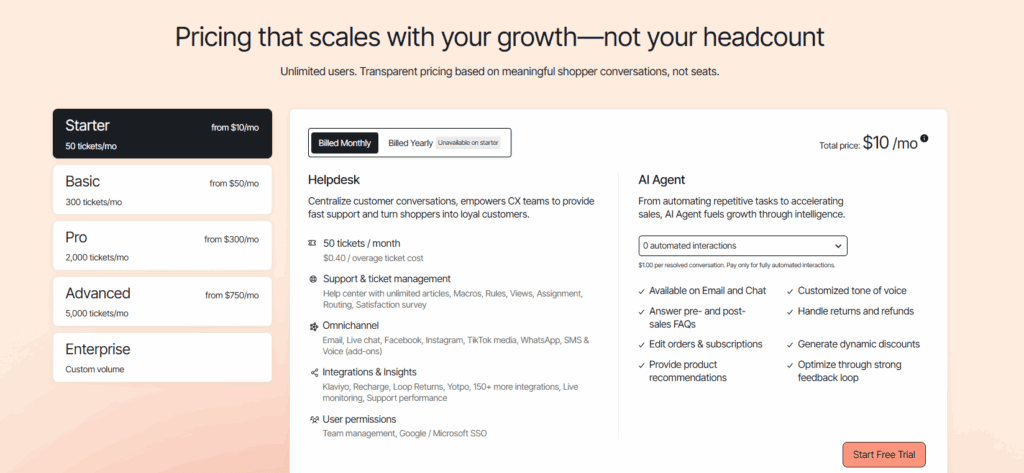
Gorgias runs on a base plan billed by ticket volume, with the AI Agent as an add-on.
Paid plans start at $10 per month for the Starter tier and scale to $50, $300, and $750 as your ticket volume grows.
AI-resolved tickets cost around $1.00 each. It's not the cheapest option, and that per-resolution cost can add up at high volume, so do the math against your monthly ticket count.
At low volume, Gorgias is overkill, and a free live chat plus a tidy Gmail inbox will do the same job for $0. Wait until tickets start slipping through the cracks before you pay for it.
Alternatives
- Richpanel. A more affordable, ecommerce-focused helpdesk with AI that drafts replies from past tickets and Shopify order data, without steep per-resolution pricing.
- Freshdesk. Freddy AI handles ticket summaries, auto-responses, and routing out of the box, at a price that works for smaller WooCommerce stores.
2. Tidio
Best for: Answering pre-sale questions on your product page with live chat and an AI chatbot.
Not for: Stores that want one tool to run their whole support desk.
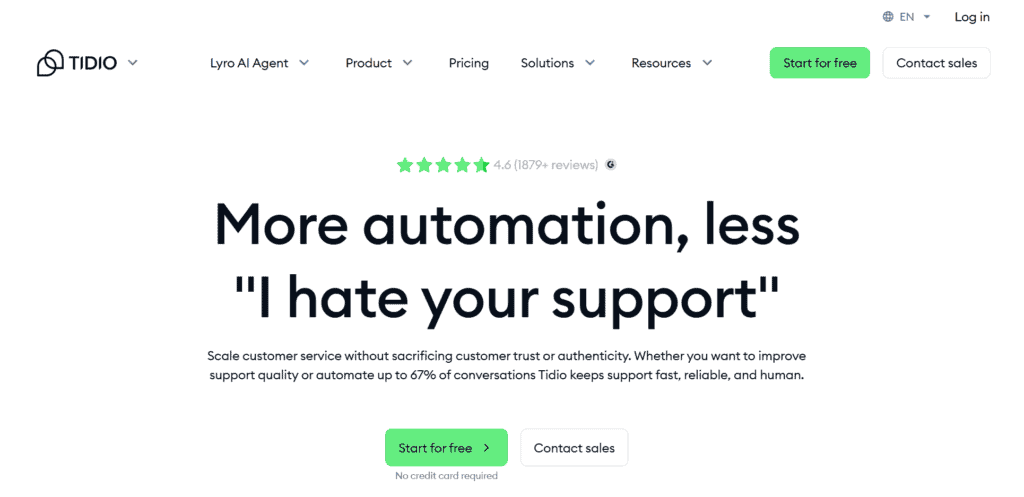
Tidio is a live chat and AI chatbot tool that catches customers while they're still on your product page, which makes it the easiest way to turn a hesitating visitor into a buyer.
Most support tools wait for a ticket. Tidio jumps in before one exists.
Its Lyro AI chatbot answers common product, shipping, and returns questions on its own, and hands off to you when a question needs a human.
That matters, because a quick answer at the right moment is often what saves a sale.
The numbers back this up.
Live chat has the highest satisfaction of any support channel, at 73% versus 61% for email and 44% for phone, based on an eDigital benchmark of 2,000 consumers.
It's also a strong fit for dropshipping specifically, since so many lost sales come down to a pre-purchase question that never got answered.
Cart abandonment sits at around 70%, and the top reason is unexpected costs like shipping, per the Baymard Institute. A chatbot that surfaces shipping and returns info early can claw some of those carts back.
Example in action
Say you're dropshipping a posture corrector. A visitor lands on the product page but hesitates because they're unsure about sizing.
Instead of bouncing, Tidio's chatbot answers the sizing question on the spot, suggests the right size, and nudges them toward checkout.
If they ask something the bot can't handle, it passes the chat to you instead of leaving them stuck.
Pricing
Tidio has a free plan that covers 50 conversations a month, which is enough to test it on a new store.
Paid plans start at $24.17 per month for Starter and $49.17 per month for Growth, billed annually.
The Lyro AI chatbot is a separate add-on from $32.50 per month, so factor that in if the AI is the main reason you want Tidio.
Tidio is built around the chat widget, so for full ticketing across email and social, you'll still want a helpdesk like Gorgias. The free chat conversations also run out fast once traffic picks up.
Alternatives
- Juphy. An AI sales and support agent built for ecommerce stores. Its pricing depends on monthly visitors and product count.
- Shopify Inbox. Free and built into Shopify, it handles live chat across your store and the Shop app. It's lighter than Tidio, but hard to beat on price.
3. Manychat
Best for: Automating customer conversations across Instagram, Facebook Messenger, WhatsApp, and TikTok.
Not for: Stores that get little to no social traffic.

Manychat automates your DMs and comments across Instagram, Messenger, WhatsApp, and TikTok, which makes it the right pick if paid social is where your customers talk to you.
If you're running paid social ads for your store, you already know how fast the DMs and comments pile up when a product takes off.
That volume is real.
Around 65% of consumers use social-messaging apps to reach customer service, per HubSpot, so a lot of support now lands in your DMs, whether you planned for it or not.
Manychat uses AI Intent Recognition to read what a customer means, not just match keywords, so the replies feel less robotic.
For dropshippers, it handles everything from shipping questions to abandoned cart follow-ups without you being online around the clock.
Example in action
You post a reel for your winning product, and it starts getting comments.
Someone drops a 'Love this!' at 2 a.m. Instead of that going nowhere, Manychat slides into their DMs with the product details, suggests similar items, and adds a discount code to push them over the line.
That one comment just became a potential sale.
Pricing
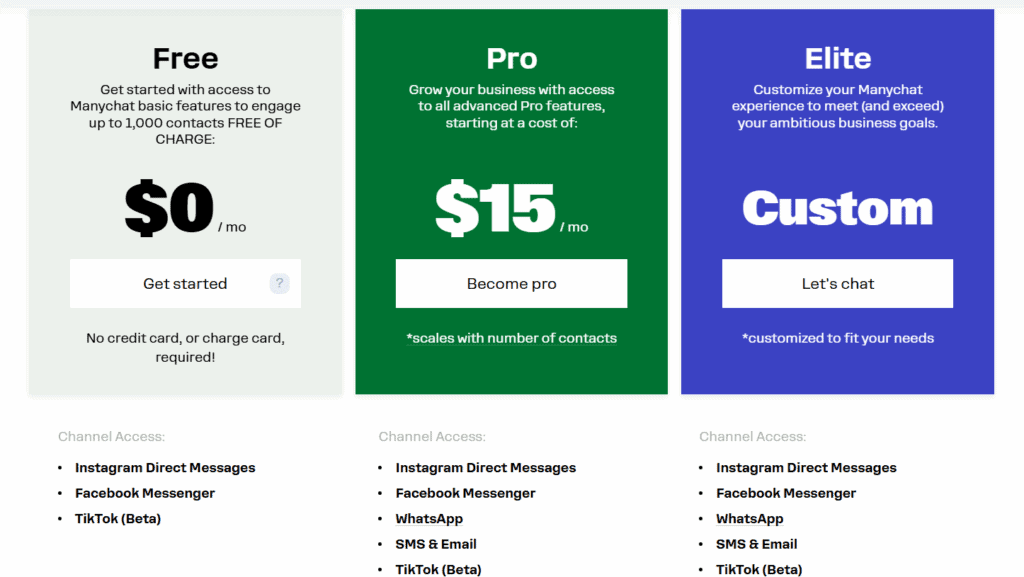
The free plan covers up to 25 contacts and comes with Manychat branding, so it's really just a taster.
The Pro plan starts at $15 per month for 500 contacts and scales up with your list size. WhatsApp, SMS, and email are billed separately on top.
You should also know the AI features aren't in the base plan. They come as a separate add-on, so factor that in before you commit.
If your sales come from Google or a niche audience that emails you, Manychat solves a problem you don't have. The free plan's 25-contact cap also means you'll hit a paywall quickly once it works.
Alternatives
- Chatfuel. Another social media automation tool built mainly for ecommerce stores. Pricing starts at $19.99 for 1,000 contacts.
4. Loop Returns
Best for: Automating returns and exchanges so they never reach your inbox.
Not for: New or low-ticket stores.
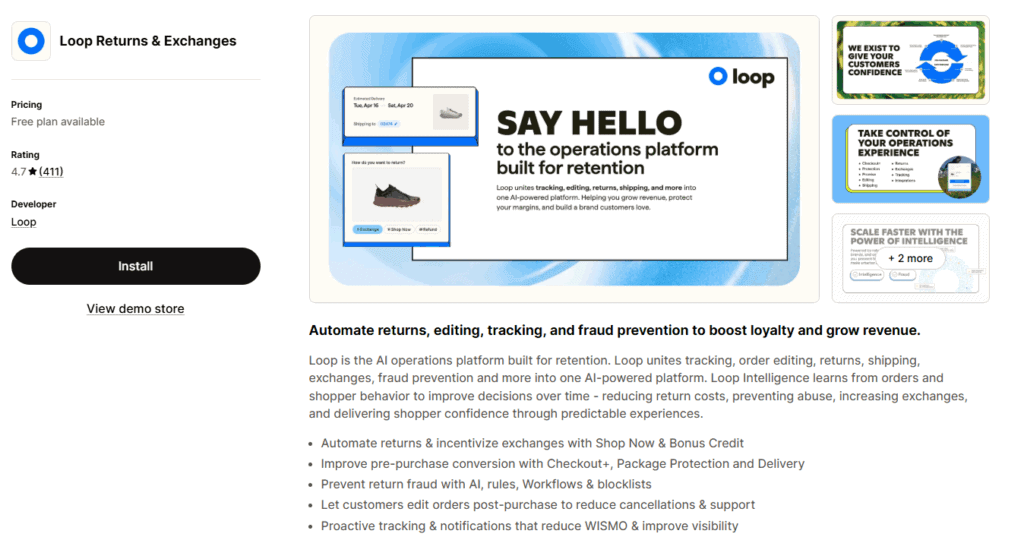
Loop Returns gives customers a self-serve portal to handle their own returns and exchanges, which turns one of dropshipping's biggest headaches into a flow that runs without you.
Returns are messy in dropshipping.
You didn't pack the order and you don't control the shipping, but the customer still comes to you for a fix.
And the scale is bigger than most beginners expect. US shoppers returned $890 billion of retail goods in 2024, around 16.9% of sales, per the National Retail Federation.
With Loop, customers request a return, choose a refund or exchange, and get a shipping label, all without you getting involved.
It also has built-in fraud prevention, so serial returners don't take advantage of your store.
That's something a lot of dropshippers don't think about until it's too late, especially since the NRF found 93% of retailers see returns fraud as a real problem.
Example in action
A customer orders a fitness band but gets the wrong size.
Instead of emailing you and waiting two days, they open your returns portal, select 'wrong item received,' pick an exchange for the right size, and get a prepaid label automatically.
The exchange order is created in Shopify without you touching a thing.
That's one less ticket in your inbox and one more loyal customer.
Note: this only works when you have a solid supplier relationship and enough margin to cover return shipping (check out high-ticket dropshipping). For low-ticket stores with thin margins, handling returns manually is honestly the more practical route.
Pricing
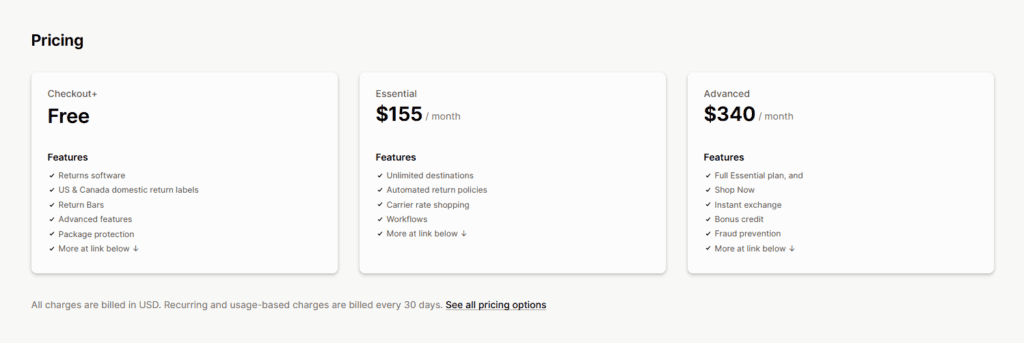
The Essential plan starts at $155 per month and includes automated return policies, carrier rate shopping, and workflows.
The Advanced plan starts at $272 per month and adds features like instant exchanges, fraud prevention, and bonus-credit incentives.
There's no free tier, so this is a real investment. The math only works once your return volume is high enough that the time saved beats the monthly cost.
At $155 a month with no free plan, Loop is hard to justify until returns are eating real hours each week. Below that, a simple return request form and manual processing is cheaper and good enough.
Alternatives
- AfterShip Returns. A solid alternative that works with Shopify and WooCommerce stores. It handles automated return labels and tracking, and keeps things simple enough for smaller operations.
- ReturnGO. A more budget-friendly option with AI-driven return rules and automation.
5. Chargeflow
Best for: Fighting chargebacks automatically, without building evidence files from scratch.
Not for: Stores that rarely see a dispute.
Chargeflow is a fully automated chargeback tool that builds and submits your dispute evidence for you, which makes it the hands-off way to claw back revenue you'd otherwise lose to disputes.
Chargebacks sneak up on dropshippers.
A customer doesn't recognize your store name on their statement, a package arrives late, or someone just disputes instead of asking for a refund.
Each one eats into your margin, and if your dispute rate climbs too high, your payment processor starts asking questions.
A lot of those disputes aren't even real fraud.
Card networks estimate that up to 70% of card fraud now traces back to chargeback misuse, and nearly half of surveyed merchants say this 'friendly fraud' accounts for more than 50% of their chargebacks.
Chargeflow uses AI-built dispute evidence drawn from millions of data points to push your win rate up.
You install it, connect your payment processor, and it handles the dispute process for you.
The case for handing this off is strong: that same report found merchants using a third-party chargeback solution recovered over 55% more than those fighting disputes in-house.
Example in action
A customer files a chargeback claiming they never got their order, even though tracking shows it was delivered three weeks ago.
Instead of you digging through order details, pulling tracking, copying email exchanges, and submitting it all before the deadline, Chargeflow does the whole thing automatically.
Pricing
Chargeflow is free to install.
For recovery, it takes 25% of the chargebacks it wins back, so you only pay when it recovers money.
The Prevent feature includes 1,000 free orders, then charges $0.20 per order after that. Chargeback alerts are billed per prevented chargeback.
If you get a chargeback every few months, the time you'd save doesn't justify the setup, and handling them yourself is fine. The 25% success fee also means a big recovered dispute takes a real bite, so read the terms before you connect it.
Alternatives
- Disputifier. A leaner, more budget-friendly chargeback tool with AI-automated responses. It's popular with dropshippers who want something straightforward without a revenue-share model.
- ChargePay. Works with WooCommerce and uses AI to build dispute evidence automatically, with a performance-based model similar to Chargeflow but notably strong recent reviews.
6. Jotform
Best for: Building forms fast so customers send the right details upfront.
Not for: Stores that want forms to live natively inside a helpdesk.
Jotform lets you build support forms in minutes, which cuts down the back-and-forth by collecting the order details you need before a ticket ever reaches you.
A lot of support headaches come down to missing information, and a good form fixes that before it becomes a problem.
It also nudges customers toward solving things themselves, which is what most of them want.
HubSpot found that 78% of CRM leaders say customers prefer to resolve issues on their own.
You can build forms two ways with Jotform:
- The traditional way, by manually adding and arranging fields, which already gives you plenty of flexibility.
- Or with the AI Form Generator, where you describe what you need ('create a return request form for my online store') and it builds the form in seconds.
You can also upload a file like a PDF, CSV, or spreadsheet, and Jotform will generate a form from it.
Either way, you end up with a clean, professional form without spending an hour on setup.
For dropshippers, the most useful forms to have are a returns and refund request form, a customer complaint form, an order issue report form, and a post-purchase feedback form.
As a bonus, Jotform also lets you build AI Agents that guide customers through filling out forms and answer basic questions around the clock.
Example in action
You're getting a flood of return requests after a promotion.
Instead of customers emailing you with half the details missing, they land on your return request form and fill in their order number, reason for return, and preferred resolution.
By the time the request hits your inbox, you have everything you need to action it in one go.
Pricing
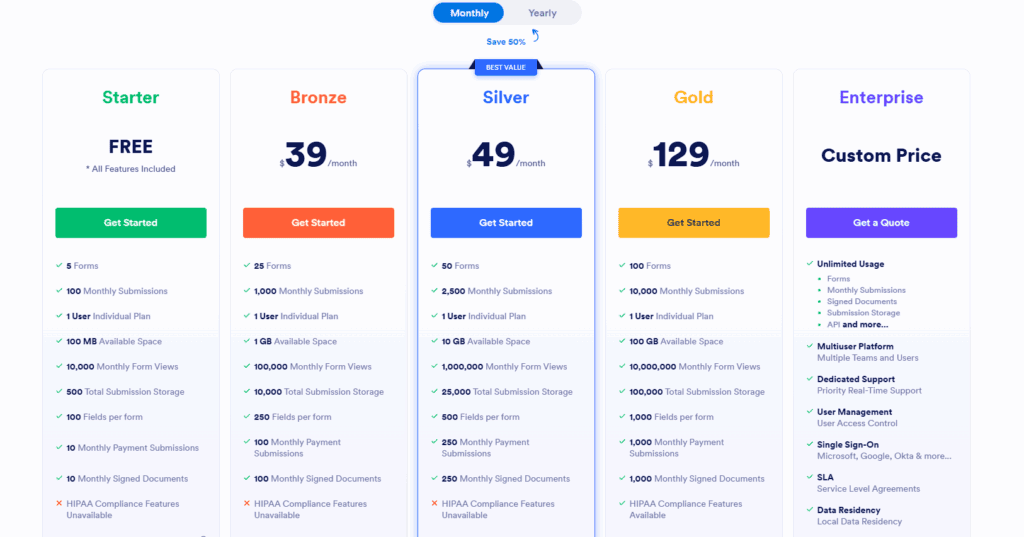
Jotform's free Starter plan includes 5 forms and 100 monthly submissions, which is plenty to test things before committing.
The paid plans are Bronze at $39, Silver at $49, and Gold at $129 per month, each adding more forms, submissions, and storage.
For most dropshippers starting out, the free plan is more than enough.
Jotform is a standalone form builder, so replies still land in your email unless you connect it to another tool. If you already run Gorgias, its built-in contact forms may cover this without a second subscription.
7. Zigpoll
Best for: Collecting customer feedback at the right moments and using AI to turn it into action.
Not for: Stores that won't act on the data.
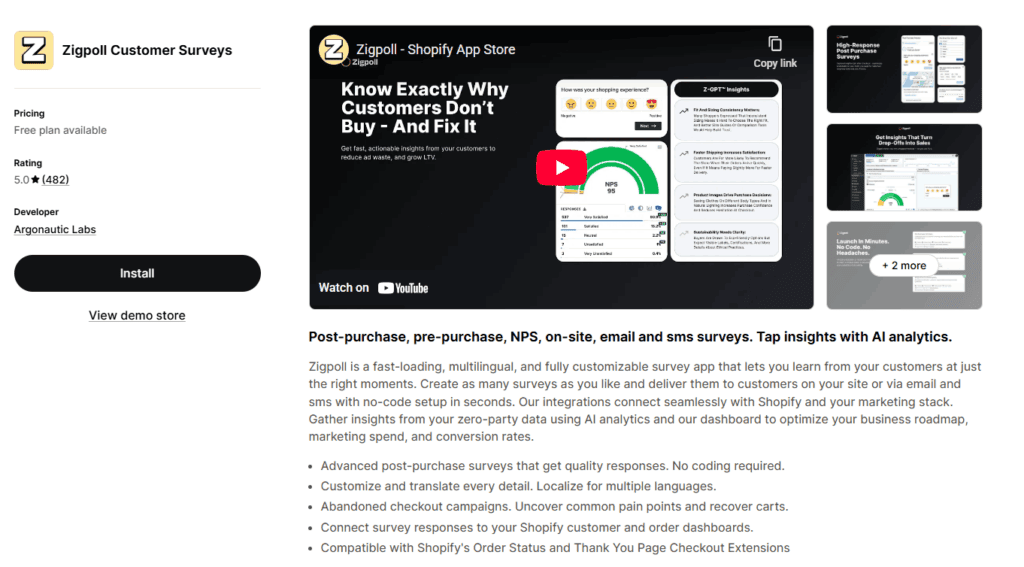
Zigpoll is a survey app that collects feedback at key moments and uses AI to turn the responses into insights, which makes it the tool for understanding why customers do or don't buy.
Most dropshippers skip surveys entirely, which is a missed opportunity.
That feedback is worth chasing, because keeping a customer is far cheaper than finding a new one.
Raising retention by just 5% can lift profits by 25% to 95%.
Zigpoll is a fast-loading, multilingual survey app that lets you learn from customers at the right moments, whether that's on-site, post-purchase, or by email and SMS.
What makes it genuinely useful is the AI layer on top of the responses.
Instead of staring at a spreadsheet of raw answers, you get insights you can use to adjust your marketing spend and product pages.
Every plan, including the free one, comes with weekly AI-generated insights, so you're not just collecting data; you're told what to do with it.
For dropshippers, the most valuable surveys to run are post-purchase satisfaction surveys, shipping experience feedback, and abandoned checkout surveys.
Example in action
You're getting decent traffic from ads, but your conversion rate is lower than expected.
So you set up a Zigpoll survey that triggers when someone abandons checkout, asking one simple question: 'What stopped you from completing your order?'
Within a few days, the AI flags that most answers mention unexpected shipping costs. You update your product page, and your conversion rate climbs.
Pricing
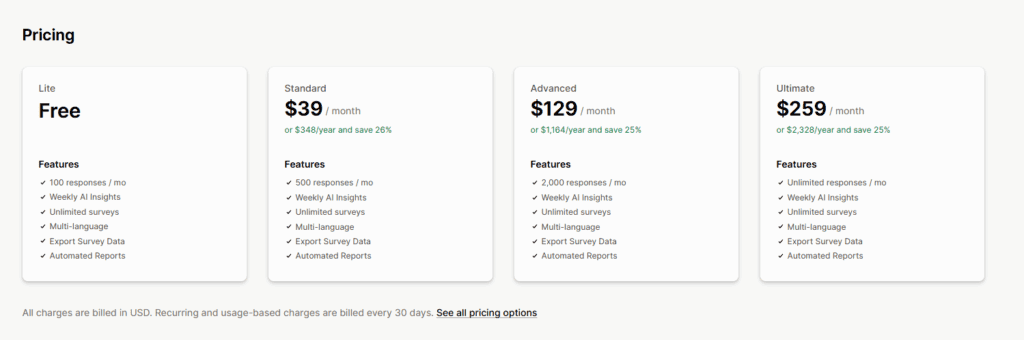
Zigpoll's free Lite plan includes 100 responses per month and weekly AI insights.
The Standard plan is $39 per month for 500 responses, Advanced is $129 per month for 2,000 responses, and Ultimate is $259 per month for unlimited responses.
Paid plans are cheaper if you pay annually, with around 25% off.
A survey tool only pays off if you change your product page or shipping based on what you learn. If you're still validating your first product, your time is better spent getting sales than running surveys.
Alternatives
- Fairing Post Purchase Surveys. A clean, ecommerce-focused survey tool with AI insights and a free plan, great for stores that want something simple.
- Survicate. It integrates well with WooCommerce, offers post-purchase and on-site surveys, and has a free tier that covers the basics for smaller stores.
Why do you need customer support tools for your dropshipping store?
Because doing it all manually just doesn't scale.
When you're dropshipping, customers have questions at every stage. Before they buy, they want answers fast, which is where live chat comes in.
After they order, they want to know where their package is, which is where order tracking and a helpdesk do the heavy lifting.
And when things go wrong, you need a solid system for handling returns, refunds, and chargebacks before they spiral into disputes that hurt your standing with payment processors.
Then there's the bigger picture:
A helpdesk keeps your tickets organized in one place so nothing slips through the cracks, and surveys help you spot why customers are unhappy before it becomes a pattern.
Each of these tools addresses a specific pain point associated with the dropshipping model.
Together, they cut your response time, reduce manual work, and make your store look far more professional than competitors who are still winging it.
Frequently asked questions about dropshipping customer support tools
Do you need to do customer service when dropshipping?
Yes. Even though your supplier ships the product, you are the store the customer bought from, so every question, complaint, and return comes to you.
Your supplier won't reply to your customers, and they won't handle refunds or chargebacks for you. Good support is what separates a one-time buyer from a repeat customer, which is why it's worth setting up the right tools early.
What is the best free customer support tool for dropshipping?
For most new stores, Tidio's free plan is the best starting point, since it puts live chat and a basic AI chatbot on your product pages at no cost.
Shopify Inbox is another strong free option if you're on Shopify, and Jotform's free plan covers your support and return forms. You can run all three for $0 until your ticket volume justifies a paid helpdesk.
How do you reduce 'where is my order?' tickets in dropshipping?
The fastest way is to be proactive: send automatic tracking updates and set clear delivery expectations on the product page before the customer has to ask.
A helpdesk like Gorgias can auto-reply to tracking questions by pulling live order data, and an order-tracking page lets customers check status themselves. Since dropshipping shipping times are often long, setting honest expectations upfront is half the battle.
Final verdict
That's it: the seven best customer support tools to help you handle the chaos that comes with running a dropshipping store.
So, what's our final verdict? What's the best customer support app for dropshipping in 2026?
Final verdict: the three best customer support tools for dropshipping stores are Gorgias, Tidio, and Manychat. Gorgias is the strongest all-around helpdesk for stores that are scaling, Tidio is the best free way to catch pre-sale questions on your product page, and Manychat is unbeatable for social-media-driven stores.
Still deciding? Check out our overview here:
| App | Best for | Price per month |
| Gorgias | Helpdesk | $10 / $50 / $300 / $750 |
| Tidio | Live chat and chatbot | Free / $24.17 / $49.17 |
| Manychat | Social media conversations | Free / $15 / Custom |
| Loop Returns | Returns and exchanges | $155 / $272 |
| Chargeflow | Chargebacks | 25% of the recovered amount |
| Jotform | Forms | Free / $39 / $49 / $129 |
| Zigpoll | Surveys | Free / $39 / $129 / $259 |
Want to learn more about dropshipping?
A few we'd point you to:
- Cross-Border VAT for EU Dropshipping: IOSS & OSS in 2026
- How to Use AI to Find Winning Products (Best Research Tools)
- Product Liability in Dropshipping: What You're Responsible For
New to dropshipping? We cover what it actually takes in our guide on how to start dropshipping here.